Wednesday, April 15, 2009

Free Gay Restroom Vids


Famous NOT wearing horned Viking helmets. We found some but very little and surely would be for ceremonial use. Also, if you think about it a little, so that want big horns and angry in the middle of a battle. I think that would hinder more than anything else. The real Viking helmets had this aspect, which is pretty scary. We tend to see Vikings dressed in skins and horned helmets, but in reality, as has been proven-they did not wear horns on their helmets, was an invention of the Swedish painter Gustav Malstrom in the pictures he made in 1820 for the epic Frithiof's Saga. The objective sought by the painter to put an unrealistic horns was to portray the ferocity of the warriors from Northern Europe almost demonic beings. But the passage of history as reflected in the manner to which we have used all the wrong way and that as part of the mythology. In fact a helmet with a horn is only for display or part of an elaborate costume, but I think they should banish some myths about the warriors of the North:

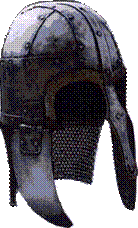
berserkers Here some of the real helmets Kriegers: that other is really a viking helmet, of which they made with animal skins, logic is a replica. the appearance of the helmet hid his face and gave an aura of ferocity.

this is a town that this Viking museum in Stockholm, dating from the ninth century. The Viking heyday was between the ages VIII to XI. precious reproduction, faithful to the original, a hull of a Viking King.

Buying Out Community Service

The True Viking Helmets Helmets


These two imposing helmets with lyre-shaped horns were found in a warehouse in the late period of the Bronze age and was supposed to be reserved for ritual ceremonies. Stop arms, helmets Viks played on the front face with big eyes and crooked nose, on top, these fish are adorned with a plume set to a dividing slot. The metal is treated with the technique characteristic of the embossing rolls of the central and northern workshops. For this reason it is suspected that may have been luxury items imported into Denmark. The entry into combat during the Late Bronze Age was made to guarantee survival. All military equipment was invented and technologically prepared for it. The swords left to split into the juncture of the blade with the handle to the first assails violent. Were withdrawn from circulation rivets antiquated swords in splicing, and designed a much more robust: the sword that holds the handle to the blade using a metal pin. Is this tongue in its haft, which is drilled to accommodate the handle of wood or bone. The sheet is also stronger by adopting a bay leaf profile very sharp, sharp tip. Generalize and circulate all the swords pistiliforme sheet language or carp.

Warriors urnfield stunning round shields pregnant. We know, and so the specimens tested Clonbrin Irish (County Longford), Annandale (Leitrim) or Churchfield (County Mayo), sometimes the shields were made of leather. However, many bronze shields have been recovered from tombs and special deposits of Central Europe, Denmark and the British Isles, to demonstrate that the manufacture of the same response to a similar model, proven effective and therefore widely accepted. The shield is a circular plate, worked to hammer, with a central umbo, which fits the handle on the back. By embossing are arranged around the umbo, nerves concentric circles alternating with embossed areas (or "or studs). This design has decorative purposes, but also technical. The shield with ribs and rows of studs is a weapon stronger and resilient. The prototype had to be Central. The British Isles are large sample and use the expertise of its architects. Notable examples are the shields of Athenry (County Galway) in Ireland and Rhyd-y-Gorse, Wales. Danish bronze-smith workshops not only adopted the model in its original version, as shown by Mose Taarup shield, but it introduced changes Nordic stamp and seal. The coat of SØRUP, for example, shows a different back, incorporating a cross-shaped item in the tondo, without deviating from the established scheme. Others are unique Danish crowns adorned with circles of ridges and studs. And very special is the copy Nackhälle Swedish, in which the strings of studs bird motifs drawn in a row. better equipped fighters entered the scene in real or ceremonial with good armor. Outstanding and very famous for its timing and because it discussed a hypothetical European precedent of Mycenaean armor is the Caka (Levice) in Slovakia. The piece was found in a niche of one of the well tombs covering a huge mound. Shells such as due to a pattern Caka instrumental in metal production, such weapons. The tradition of adopting the Western bronze-smith and from it produce splendid specimens of bronze armor. Up to nine shells were found between 1974 and 1976 at the site of Petit Marais Marmesse (Haute Marne). As in the shields, the rows of studs act of reinforcement and decorative lines. In Marmesse breastplates decorated reaffirms that the adjustment of the metal parts to support the human body anatomy. Metal trim adorn and reinforce the banks. Even tacking rivets are aesthetically integrated into the game art metal.
Simple but impressive are the crest crested helmets, well represented in deposits of Bavaria, the French regions of Loire-et Oise and Cher and other Atlantic sites. One of them, recovered from a reservoir of the River Seine as it passes through Paris, may be indicative of technological assumptions that are built. Two bronze plaques are found and turned over along the backbone. Iron nails in the flanges would subject the lining to the leather. A double bevel base is the border town of weapon. The profiles of these pieces look the aesthetics of technology and this in turn will not be reluctant to produce eye-catching weapons, as well as functional.

is not known what the function of a couple helmets found in the marsh Brons in Viks, north of Zealand (Denmark), but obviously had to invest to respect and glory to its owner. Belong to the class of helmets with curved horns lyre-shaped. Its summit was adorned with a plume of feathers or other ornamental ridge, inserted into an open slot in the spine of downtown. This groove marks the meeting point between the two brass plates that form the hull, but its base emerges a curved hook, like a predatory beak. The metal plates are dotted with puffs, but the larger ones were placed, by way of an eye, below two arched lines in relief and between the said hook. Helmets are lined superhuman powers. The technical virtuosity of its manufacture should be commensurate with the rank of their audience and very determined to play a role.

We can only surmise that the Viks helmets served a religious ceremony. It has been postulated that the expert workshop that was left outside Denmark, Czechoslovakia, or in central Germany. Question difficult to prove. If so, it is likely that Viks helmets were not made to order, but would have gone to ground as gifts Nordic invested with a special social and religious significance.

Sunday, April 12, 2009

Simple Machines In Art

Heathen Frederiksborg cemetery in Odense


Through a local initiative of UÍAS Vikkelsø Solvej Blótlaug, Forn Sidr is possible that this cemetery opened in 2008, which will be reserved exclusively for members of Forn Sidr and kindsfolk his desire to be buried there (parents, siblings, spouses and unmarried, and others). (It ignagura the weekend of February 7 by Søren Fisker (One of the contributors to the IASC - International Asatru Camp Summer in Denmark) The facility will be located on municipal property not far Kirkegård assistants, Odense University Hospital.
Our member survey from 2005 showed that even among Asatruar there are some who want a coffin for burial. Therefore, the design is, that this is possible, as well as burial urn.

The main feature of the facility is 18 meters long stone xx as a ship, which is partially in the shade of a large protected tree. Around the plot is a mosaic border that marks the transition between the park of the plot, which is fully maintained as an area covered grass. There is no one grave markers, but individuals from a burial site and stored in the access management office of the cemetery. However, the facility houses a wall, where the dead can be commemorated by a plaque as a small shield.
The wall, which is about 1 meter in height, consists of a number of specific elements, which surround the whole plot. To date, only 9 elements were established. Each of the points raised has three arches, under which a circular plate at any wanted materials (wood, metal, stone, etc.) with a diameter of 50 centimeters can be fitted. Apart from basic information on the dead, we would love to see it adopted, ie, appointments or sentense, giving a view of the person who is now with us only in memory.
obviously not the plan to all Danes asatruars should be buried in Odense. Everyone is, of course, welcome, since there will be room for many people for many years. But the facility also should be viewed as a pilot project, which can act as a switch of land for similar projects in other parts of the country, where the desire / need for a pagan cemetery is present.

When installation is complete, anyone is free to reference it in any application to other municipalities or religious authority.
Solar Wheel A beautiful sculpture that the architect had done a project originally was unfortunately withdrawn from the project for economic reasons, such as the construction costs of concrete and cast iron was more expensive than the city anticipated. So even the trees grow here in heaven. But see it as a challenge, and may invest in the addition of a sculpture at a later stage.
The plant is operated in accordance with the surrounding park / cemetery, and is funded mainly user. This means that Forn Sidr is not obliged to spend a fortune to maintain annual facilities. Forn Sidr will not be obliged to cover any cost of installation, unless, as the negotiations look now, the board of Forn Sidr so wish.
Therefore, there is reason to congratulate both Forn Sidr and the entire community asatru throughout Denmark, in the new cemetery. The first "official" pagan cemetery in this country of 1000 years.


Monday, April 6, 2009

Letter Of Introduction For A Dental Hygienist

Dinamarca: una mirada cultural (by G. kimber)


Danish culture is characterized by simplicity, minimalism, egalitarianism, morals and decency. Culture is an important part of Danish life and does much to promote it. Public authorities avoid interfering in the world of art and culture, and the state generously supports the community of creators and cultural institutions, without accountability or return. The Danish applied art and industrial design is recognized worldwide for its high standards of quality, craftsmanship and functionality. He has won many awards for excellence. Georg Jensen is known worldwide for its modern design in silver. Danish design is also a known name, often associated with world famous designers and architects such as Børge Mogensen, Hans Wegner and Arne Jacobsen, who gave what is probably the most famous chair in the world today: The Ant
In the literature, Denmark gave birth to the legendary Hans Christian Anderson, whose children's stories are repeated in many nations around the world until today. One of the most popular authors of Denmark in the 90's, is the writer Peter Høeg who shot to fame in the Western world with his novel "Miss Smilla's Feeling for Snow" in 1992. Danes have distinguished themselves as jazz musicians, and the Copenhagen Jazz Festival has acquired an international reputation. In film, the Danes are credited with starting the Dogme 95 movement. The avant-garde film movement started in 1995 by the Danish directors Lars Von Trier, Thomas Vinterberg, Kristian Levring and Soren Kragh-Jacobsen, whose movement is intended to refine the film reject the costly special effects, postproduction modifications and other gimmicks. The emphasis on purity push the filmmakers to focus on the true story and the performances of the actors.

The Hygge is an important part of Danish culture and almost a national obsession. It refers to a particular state of mind or an environment where the outside world is closed, creating a warm, intimate and friendly. The desire of hygge can be found throughout the dark winter. Many Danes put much effort in creating this "cozy and comfortable" environment in their own homes. Café candles and soft music are essential elements of an atmosphere hygge.