Sunday, March 29, 2009

Brussels Plus Size Shopping

VOLKERWANDERUNG- LA MIGRACION VOLK


The Völkerwanderung Arief or migration occurred about 300 to 700 of the EC, when the Germanic tribes that came into control of the territory that became known as the Western Roman Empire. As the Empire fell apart by political and military, many tribes migrated en masse to different latitudes mainly driven by the invasion of their territories by Asian tribes, the population increase in their settlements and climate change. These raids led to the war of occupation, this resulted in the permanent establishment of various tribes in Britain, continental Europe, the Mediterranean region and North Africa. The role played by the Germanic tribes in the formation of the Middle Ages is now interpreted as a direct consequence of the practical inability of management by the Roman Empire in its entirety, space had to be filled somehow and it was replaced Germanic for leadership. Among the most important events that occurred in this stage of development of the tribes found their conversion to Christianity, it was given in various ways, some tribes were converted to Arianism while still were outside the Empire, other tribes were converted to Arianism until they entered the territories of influence of the Empire. Other tribes were converted directly from paganism to Catholicism. The most symbolic of this change of religion took place during the Saxon wars in 772-773 CE, when Charlemagne entered the territory of Saxony to subdue the tribe Engrians and destroyed its sacred symbol Irminsul. Germanic Migration


Migration of the Germanic tribes to the Roman Empire Ancient Spirituality

Before being converted to Christianity, Germanic tribes professed polytheistic spirituality. In the writings of Tacitus, he associated the patron god of the tribes with Mercury, which on certain days of the week received human sacrifices, while other gods associated with Hercules and Mars receive animal sacrifice. One of the major female deities was Nerthus, revered as Mother Earth, believed the goddess would intercede in human affairs. His shrine was on an island where there was a magic forest. He spent a carriage covered by a veil and only a high priest could touch it, it mentions that the priest could see the goddess to enter his carriage. Pulled by oxen, the coach had to walk the towns and everywhere the submission was made a great feast. During the passage of the goddess, the tribes did not go to war or even touched the guns. When the priest decreed that the goddess was over his dealings with men for that period, the carriage was washed along with her veil, in a secret lake. For the slaves who helped in the task of purifying the chariot were put to death and then thrown into the lake. Tacitus also describes the tribes did not use temples to worship their gods or worship in the human representations. Instead they consecrate woods and groves to individual gods. Divination and sorcery were common and were practiced in the Greek methods perceived as simple, using specific woods and special marks. The priests solemnly invoked the gods with eyes focused on heaven and respected their designs in a way not insidious; also interpreted magic in the singing of the birds, horse behavior and individual fighting between enemies.


Volks Germanic

Alamannen: early formed the Confederation Suebi tribes, along with Marcomanni, Hermunduri and Quadi. From the regions surrounding the River Elbe, Alammanes riders were first seen by the Romans in the year 213 BCE. In 233 BCE, they ransacked the strong Romans left, reaching the Saar and Moselle rivers in the west and Lake Constance in the south were also established in the middle of the river Elbe. Appeared in the story again in the years 242, 253 & 254 BCE, in the years 259 & 260 BCE reached Rhaetia and Mediolanum (Milano). The Franks were defeated in 496 or 497 CE in Tolbiacum. Carried by the migration of the Franks in the sixth century, the Alamanni had to enter the territory of Alsace in the west and the river Lech in the east, the south crossed the Rhine and Lake Constance, reaching the Alpine valleys. There is an important archaeological site Alamanni, a cemetery in the town of Schretzheim. According to research Herbert Schutz, settlements with names ending in "ingen", "heim", "statt" and "weil" were established between the V-VII centuries CE, while the settlements with endings "dorf", "Stetten" "hifen", "weiler" "bach", "beur", "Hausen", "wang" and "Felden" were established after the seventh century. In the present descendants of the tribes Alammani can be found mainly in the south of Germany, Baden-Württemberg and Bavaria and Austria, Vorarlberg, also in the Germanic-speaking part of Switzerland and the Alsace region France.

Anglos, were a tribe who came to Britain from the Peninsula Jutland. They lived in Schleswig-Holstein in northern Germany around the year 100 CE. This tribe is related directly to Thuringia and example of this can be seen in the law written IX century "Lex et Werinorum Angliorum, hoc est, Thuringorum" where both tribes legally related. Migration to Britain occurred during the V and VI together with the tribes Sachsen, settled in the north, east and center of Britain, places that later became known as East Anglia, Deira and Bernicia. Were also mentioned by Tacitus in Germania, "after Langobardos came Reudigni, Planes, Angli, Varini, Eudoses, Suarines and Nuitones, all guarded by rivers and forests. There is nothing remarkable about them individually, but share a common worship of the goddess Nerthus, or Mother Earth.. "Are also discussed by Ptolemy mentions them as immigrants in the second century. At present the descendants of the tribes Angli can be found in the region of Schleswig-Holstein in Germany and southern England. Burgundians, were a Germanic tribe that was established near the Vistula before migrating to the west of the Rhine River valley. They were first mentioned in 278 CE when the Vandals invaded Rhaetia. Were neighbors of the Alamanni, who struggled with some sites salt about 369 CE. In 413 CE the Roman emperor Honorius recognized them as a tribe federated to Rome, giving them land, their capital was Worms. The EC 435 was defeated by a coalition led by Aetius Roman soldiers and mercenary Huns, this resulted in the defeat and death of 20.000 Burgunder. Federated tribe were revived as Rome in 443 CE in Western Switzerland, Eastern France. Gundobad King established the capital in Geneva Switzerland, and I think the "Lex Burgundionum, or Gundobada Lex." Later he became a double kingdom, with a capital in Geneva and one in Lyons. In 532 CE were conquered by the Merovingian Franks and their kingdoms were divided between the Frankish kings. About the origin of the tribe, the archaeological evidence is known today shows that in the group of Lebus-Lausitz about 100 CE, known as a cultural group from Southeast Przeworsk later settlements of the Burgundians in the middle of the river Oder. In the present descendants of the tribes can be found in Burgundy in eastern France, southwest Switzerland and northwest Italy. Cheruscos: they were a tribe that inhabited the river Rhine and amended in the forests of West Germany. They were protagonists of the Battle of Teutoburg in 9 BCE. Arminius, one of its leaders, defeated three Roman legions under the command of Varus governor. In this the descendants of the tribe Cherusci are scattered among the population of the region Saxony Lower Saxony in Germany.

Franks, were a tribe that appeared in history in the year 231 CE when the Roman legions fought Bonna amended them in the lower River Rhine. Franks's name however, was described to 256 CE. According to Gregory of Tours free tribes claimed descent from the tribe Sicambri, integrating a coalition that inhabited the lower and central regions of the Rhine River on both sides of the river, as Amsivari, Bructeri, Batavia, Chattuari, Chamavi, Sugambri, Tencteri, Tungri and Usipi. In 355-358 CE, the Roman Emperor Julian found along the river Rhine under the control of the Franks and agreed a peace treaty with them, giving them much of Gaul Belgium and turning them into a federated nation of the Empire. Conquered much of Central Europe for 800 EC and are responsible for the conversion to Catholicism of the majority of the Germanic tribes. In the present descendants of the tribes Free can be found in the Netherlands, in western France and eastern Germany.

Goths: they were a tribe from southern Sweden, which later migrated to Eastern Europe, in the Vistula river amended. During the early third century CE they migrated from the Vistula River in Poland today, north of the Black Sea. The most important leader of the Goths was Ermanaric, his kingdom was destroyed by the Huns from 370 to 380 CE. After the defeat, a part of the tribe migrated westward to form new kingdoms in present Italy and Spain. The other part of the tribe remained in the east to form a new kingdom, whose tribes were the most representative and Kolbjazi Varangian. The Slavic peoples Goths called "Rus", meaning people blond or red hair. In the present descendants of the Gothic tribes may be found in Sweden in the Baltic region, in Spain and Central Europe.

Jutes, were a tribe originally from the peninsula Jutland, Denmark today. Part of the tribes migrated Jutas EC V century along with the Saxons and the Angles to Britain. Their main settlements were the county of Kent and the Isle of Wight. In the present descendants of the tribes Jutas can be found in Denmark and southern England. Langobardos: they were a tribe from Scandinavia. According to legend Paolo described by Deacon in the eighth century CE, the tribe was originally known as the Winnili and received the name "Langobardos" or "long beards" directly from God Godan in sponsoring a battle against the Vandals. Amended appear later in the River Elbe in Lower Saxony, and then migrate the region of Bohemia and then of Pannonia. In 569 CE the tribe migrated to Italy to establish a kingdom of a legacy that still exists nominal capital of Lombardy and Milan. In the present descendants of the tribes Langobardas can be found in Northern Italy in the region known as Padania or Langbard.
Saxons, were a tribe first mentioned in history by Ptolemy in 150 CE, the author comments that came from the Lower Jutland and Schleswig-Holstein in Germany. Among the original tribes that made up the Sachsen can find the Reudigni, Planes, Agradingun, Angerona Aringon, Astfalon, Bardongavenses, Derlingun, Firihsetan-Virsedi, Guddingen-Göttingen, Holtsaeten, Nordalbingi, Nordliudi, Nordsuavi, Norththuringun, Sahslingun, Scopingun, Scotelingun, Steoringun, Sturmarii / Sturmera, Thiadmariska, Waldseton, Waledungun, Wigmodia-Wihmodi and Uuestfali. The Saxons migrated en masse along with the Angles and the Jutes in the V century CE to Britain, although they were mentioned in that region since 365 CE. In the present descendants of the Saxon tribes can be found in the northern, eastern and central Germany.
Sueba: it was a federation of tribes that included the Marcomanni, Semnones and Hermunduri (precursors of Thuringia and Alamannen).

Thuringia, were a tribe that apparently came from the Elbe and Saale River in central Germany today. They were known as jockeys and practitioners of burial, showing possible links with the cultures of the eastern steppes. Thuringia originally came from the tribe of Hermunduri and lived in coalition with some Anglos, Warni, Langobardos, Ostrogoths and Alamannen. The Thuringia were subdued by the Franks in the sixth century CE with the aid of the Saxons. In the present descendants of the tribes can be found in Thuringia in central Germany.

Vandals: They were a tribe from Przeworsk culture, originally from Poland. The tribe migrated from this region into Gaul in 406 CE, under the command of King Gunderic. Then attacked Spain in 409 CE. Following this migration was with them a band of Confederate Alamannen Suebi, who created a kingdom in Galicia. After the king of kings followed Gunderic Gaiseric, Huneric and Trasamund. For the 496 CE, the Vandals left Spain to migrate to Africa. The kingdom of the Vandals finished between 533 and 534 CE. Modern concept of the Volk

The idea of a nation of Germanic peoples was expressed openly in the nineteenth century writers, thinkers and artists after the Napoleonic Wars, as Johann Gottfried von Herder, Anthony Smith, Richard Wagner, Friedrich Nietzsche, Johann Goethe, who called for an ethnic nationalism, a form of social organization in which the state derives its political legitimacy of the cultural history of ethnic groups. However, this social identity has been implicit since the Middle Ages and was the fuel for the Protestant Reformation, which drove many Germanic territories so the political and religious power of the Roman Catholic Church. At present there are many groups that support and promote Reconstructionism Volk Traditionalist throughout the Western world, Europe, America and Oceania.

Thursday, March 19, 2009

Car Starter Installation Ny

I (Primera noticia de Odín)


maiden
words one has to grow,
nor married, as in castor
his heart was set, with the inconstancy
chest.

The arch is broken, the flame that burns
howling wolf, the raven croaks, growls
the pig, a tree without roots,
to wave grows, the pot boiled, the dart

flying, falling wave,
ice overnight, the serpent,
talk in bed with a woman, or the broken sword,
the game of bear or a king's son,

sick lamb, the voluntary slave,
völva good words, the body recently

newly planted field, that nobody believes in it, or very soon
the son
decide in the field and time and the right child,
are two dangers.

The murderer's brother, if we find along the way, never trust the man so that all created things. For peace to women who speak falsely is riding horse without bridle slip on ice,
horse happy and still young, still poorly tamed,
or rowing with the wind in its sails on a ship without a rudder, or restrain
reindeer hand a wet batter.

speak with clarity as well know two things:
man moves his humor with the lady,
the most beautiful words we say without thinking, and deceives
the trial of the wise. Beautifully

speak and offer riches
lady who wants to love, praise
clear the body of the girl, who loves
receive love.

reproach no one should
love to another, never;
moved by the wise, do not move to fool
friendly faces of color.
No one should ever criticize another
what happens so many;
in the wise fool, and makes men
the burning desire.

The spirit knows what lies near the heart, is only
with his love
no worse condition for the wise man
that being happy with it.

Well I checked the juncares
there waiting for my love
flesh and my heart was the wise virgin, although
did not.

The Billing virgin found in bed,
clear as the sun, sleeping,
pleasures of Prince
thought that there would be if he was not enjoying her body.

"And the evening will come, Odin,
to talk to the girl is bad
fate unless we agree
what we do."

quit then - I felt loved-
my true desire;
he thought it might have
his love and grace.

So then comes awake
valuable warriors all;
with blazing lights and lighted torches
knew well the dangerous path.

And in the morning when I went there
slept in the house
only found a dog, good woman,
tied to her bed.

Many good girls, if you look good,
are false and man;
checked it when I wanted to conquer the insidious
;
all the trouble I caused the wise female
nothing came of the lady.

Monday, March 9, 2009

Huge Amount Of Mucus Discharge

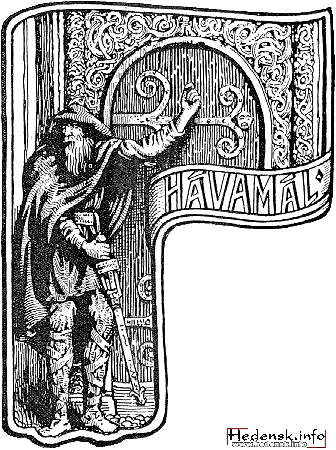
El Hávamál (el Discurso del Altísimo) Las palabras de Odin, Los dichos del Alto. del Antiguo Edda o Edda Poetico (Sæmund's Edda)..


At times like this materialism is a cancer that harasses our minds and makes us slaves of consumerism ... I have more to rely on the wise words of Wotan (Odin) who said those wise The words in the Hávamál (the Discourse of the Most High). The words of Odin, The Old Alto.del said Edda or Poetic Edda (Edda's Saemund) ... I will publish saga.La Gestaþáttr first section, the "guest section, verses 1 - 79, includes a number of maxims on how to behave with a guest or when traveling, focusing particularly on the label and the relationship behavior between hosts and guests and the sacred duty of reciprocity and hospitality, which was vitally important for travelers. The first stanza gives a practical example of conduct by way of advice.

:: I::


01
For all doors before entering,
tuck your eye, look at you
well, little is known

enemies when they feel inside. 02


"which invites Health!" A guest arrives.
Where are you going to sit? Restless is lucky
who tested the hearth
expected. Need


03 fire that comes out cold and knees brings
;
food and clothing that
need has traveled mountains. 04 need who comes to treat water, towel and welcome , a friendly, if you can do, talk and careful listening. 05


need sanity who travels far.
everything at home is easy!
In ridiculous is the low-head with people
if sensible. 06


No presumption of good knowing, beating better
gingerly, prudent
silent return home, the cautious
of evil escapes.
never have
most loyal friend that much wisdom. 07


Alert is who is going to treat,
tune your ear and street
with the ear hears, observe the eye.
In the wise call it!


08 Blessed is the man who knows
earn the praise and esteem of all;
bad is what remains silent, stuck in the chest
others.


09 Blessed are they who live as
enjoys esteem and sanity;
perverse advice was obtained often left chest
others. 10


There is no charge to make the way better than the much sanity
;
no more gold to be taken among strangers, she is
the resource poor.

11
There is no charge to make the way better than the much sanity
;
no worse for walking ballast the plain
that much beer.

12
The beer is not so good for anyone
say how good it is,
as more and more as you drink
man loses the trial.

13
The heron's call and she at the party
trial steals men;
on the estate of a prisoner Gunnlod
stayed in the feathers of that bird. Drunk


14 stayed and drunk a lot
wherever sage Fiala;
drank well after the party if the trial
makes men.

15
Quiet and wise king's son
and be brave in war;
happy and joyful to be every man
the day I die. Wait 16


the geek to live forever if you avoid entering
quarrels, but truce
gives little aging, spears
if it gave itself. Bowled
17

the idiot is in the banquet,
grumbles or say a word;
when then if you take a drink,
the trial that he loses.


That only 18 went that far
and went many places
calarles know the mood to men:
sharp mind he has.

19
Do not hit the horn, baby gingerly,
say what should or silent;
of rough forms
if anyone accuses you to bed early you leave.

20
The wolverine that the trial did not know how to use
eating health is ruined;
derision
prudent people served from the belly of the foolish man.


21 hours Pick up your livestock know
and then allowed the grass
the fool has no idea how much
be on his tummy.

22
The vile and evil man natural
much laughs;
something does not know and should know:
that he too has faults.

23
In the memo night sailing passes,
much thought;
sorry he is in the morning,
its evils as they were. 24


a fool is thought
have a friend in the whole laughing with him, he sees little
give
abuse if she is with sensible people. 25


a fool is thought to have a friend in the whole
laughing with him
here's what you see when litigation has:
few hand support.

26
Tiénese a fool for a man known
if in a sheltered corner;
then not know what else to say it
if anyone asks.

27
The fool comes to meeting place,
better to be quiet;
nobody notices his little head
not talk so much.
not know either who knows nothing when
is talking about more. 28
For

wise is that it tastes good question and answer
;
silent men never leave
thing that happens between people.

29
who never shuts up many foolish words
says:
light language, if not contained, often
his bad singing. 30


man never to be
banquet put ridicule anyone;
by wise is to elicit not be silent
and dry skin. 31
For

wise is if you take to run another guest
scoffs:
plays perhaps
bad enemy at the party who makes jokes. 32


Many
good-natured men in the party struggle in coming, then there's
grudge forever if host and guest
fight.

33
is good for man to take his lunch, but not if
banquet will;
abúrrese there, listless chew, he does little
talks. 34


For a long detour goes to a bad friend,
even if on the way home;
shortcuts lead to a sincere friend, even though
go away. 35


should go, never host
stay stuck in one place: it is pleasing
becomes upset over
if sitting longer. My
36

my house however small: it
me my lord;
if I have two goats and a thatched roof, it
better go begging. 37


My home, however small: it
me my lord
man carries heavy heart
whether to seek a livelihood. 38


Not one step of its weapons ever
man who goes beyond the plain:
never know when those roads will be needed
spear. Generous 39


did not see a good host
who refused to accept a gift or as generous
to find
annoying having to accept change. 40


Nobody is deprived and
sparing goods have saved, it saves
the beloved and hated inherited. Worse may be
expected! 41


With weapons and cloths are giving away friends,
each sees itself;
friendship lasts, if all goes well,
between two friends who give and take. 42
Friend

man shall his friend with a gift to the gift
reply;
laughter with laughter must adhere,
duplicity to deceive. 43
Friend

man will be his friend,
him and he has friends;
man friend will never
friend of an enemy. 44


If you friend which
trust and take advantage of you,
be open to him to change you gifts,
often seen looking for him.

45
If you have a little trust someone else that
and take advantage of you, tell
niceties rather keep that for false;
charged with deception fold. 46


same with that in little caps
who and who does not look good intention:
laughs with him, but shut your attempt, as he will give
of. Young


47 I was traveling alone;
loss is on the road;
me rich if I saw one encounters.
man comforts the man! The
48

are magnanimous and brave
also those living better and without pain;
cowardly man all scared,
the gift stings stingy. 49


I put my clothes in plain
two stick figures;
gentlemen appeared after covered. Shame is
naked man! 50
withereth

pine is in a clear,
, bark and needles keep it;
same with the man that nobody believes.
Why is he living? 51


More live fire entering peace
bad friends five days burn;
coming off after the sixth
and every friendship is spoiled. 52


need not always give great gifts,
with little to give you praise:
with half bread and a cup
something I became a faithful companion. 53


A small bank, small sea:
small trial of man is poorly distributed
sanity,
always a little lacking. 54


De wise man has just, wise
never happens;
life more pleasant
enjoy those who know enough. 55


De wise man has just, wise
never happens;
rarely
happy is the heart of the wise man who knows everything. 56


De wise the man has just, wise
never happens;
who does not know what fate awaits the mind is joyful
. 57


Fire gives the fire to burn all,
called flame turns;
speech by men known to man,
a fool who remains silent. Get 58


soon
who plan to take life or fortune of others:
not get
wolf paw lying or sleeping man victory. Get 59


soon the little people
and run to meet their tasks;
who sleeps much more delay;
takes care of wealth.

60
The dry logs and estimated the man's skin
birch ceiling, wood
and spent three months in
and a half year. 61


washing and eating will go to the assembly, but not well dressed
go;
pants or shoes or embarrass anyone
nor the horse, but not good. 62


Stretch the neck of the sea and the waves
the eagle looks;
well with that is that among many,
but with few who are on their side. 63


Questions and Answers
make whoever you are wise;
known as one does not know two;
if three, it will be known by all. 64


always Tactfully
cautious man should assert its strength:
giver soon discovers that no one valiant
can to everyone. 65

Words
another man says
almost always pay later. 66


In many places it was still early, and later came
other:
that beer is or is not done
annoying ever hit. 67


Llamaríanme to me all Banquet
not exactly eat
or two good friend hanged him by the leg
that I like. Thing 68


no better than
fire and the view of the sun
if man enjoys good health and living
leads flawless.

69
account with something, but lack health:
comfort about their children, relatives
to it, their wealth to that,
other works well done. 70


is better to live no longer live: Live Cow
available;
good fire in the house I saw the rich
and killed him outside.

71 The lame rides, the pastor maimed, the deaf
served in the fight;
better to be blind to be burned. Nobody takes
dead! 72


a child is helpful, though late and
born after the father died;
only relative in honor of the relative
erected stone on the path. 73


With one or two can, for language head falls;
hand I care that covers the mantle. Thanks

74
good night the pouch;
to rowing, tight positions;
in autumn, night insecure;
in five days and the weather changes,
but more in a month. 75


not know that anything not know that many fortune
obfuscate;
if a man is rich, poor is the other,
not be blamed on him. 76 Killed


wealth, relatives die,
also self dies
only glory never dies,
of those who earn it succeeds. 77 Killed


wealth, relatives die,
also self dies
know only one thing that never dies;
fame leaving one dead. 78


I saw filled the fold of the children of Fitiung ("the rich man"),
and go with the stick beggar as a flicker
fortune goes, the less constant
friend. 79


If it happens to the foolish fortune
or gains achieved for women, he grows
arrogance, not the good sense;
high presumption is full.

80
is proved: if runes consultations
those of divine origin, that higher powers
made
and tulr ("priest" Odin) supreme
stained much silent wins. 81


Day and night, praise, and the woman, burned (cremated);
the sword, tested, and the girl married;
ice, crossed, beer, drink. 82


With the wind the tree is felled;
in bonanza comes to fish,
with the dark girl say
many eyes of the day;
must navigate the ship, save the shield and sword wound
kiss the girl. 83


Drink by the fire, skating on the ice
buy skinny horse, with sword rust;
home to horse fat and loose the dog.