Saturday, December 19, 2009

Dragon Ball Dujin Bulma

Hermod, the God agile


Another son of Odin was Hermod, his special assistant, a brilliant young god,

was endowed with great speed of movement, and it was known as the

god fast or agile.

Because of this important attribute, Hermod was commonly used by the gods

as a messenger and the slightest sign of Odin, was always willing to take

to any corner of the building to comply with the wishes of his father.
Allfather
gave a magnificent corselet and helmet, which is adorned with often when

preparing for battle Odin sometimes entrusted with the care of the spear

Gungnir, ordering that the throw over the heads of the combatants to fight
point
so that his ardor could be transformed into a murderous rage.


Pray to Odin to come into our minds.

He gives and gives gold

who deserves it,

to Hermod

handed a case and thorax.

(semundo Edda). Hermod


enjoyed the war and was often called "the bravest of the battle"

and confused with the god of the universe, Irmin. It is said that sometimes accompanied the Valkyries

in his travels to Earth and often escorted the warriors to Valhalla

, and it was considered the leader of the heroes killed in combat.

Hermod distinctive attribute, besides his corselet and helmet, was a staff called

Gambantein, the emblem of his office, which carried with him wherever he went.

Hermod and the Magician.

Once, oppressed by the dark fears about the future, and unable to obtain the Norns

satisfactory answers to their questions, Odin ordered to Hermod that

put his armor and saddle to Sleipnir, which only he, as well as Odin,

could assemble and be directed to the frozen wastes of the Finns. These people, who lived

glaciers in polar regions, in addition to being capable of causing cold storms that came North

, bringing lots of ice and snow, had allegedly

great occult powers.

The most famous among magicians was Rossthiof Finns (the horse thief), which

used to attract travelers to their domains using magical arts in order to rob and kill

later. I also had the power to predict the future but always very reluctant

to do so.

Hermod, the Swift, went quickly to the North, intending to seek this

Finnish and instead of his own staff, carried the Runed Odin, which had given him

Allfather to remove any obstacle that could

Rossthiof do appear to contain it. Thus, despite the spooky monsters and traps and

unseen dangers, Hermod reached the abode of the sorcerer unharmed, and when it

attacked him, was able to handle easily, after which bound him hand and foot,

release stating that not until he had said all he wanted to know.

Rossthiof, seeing no possibility of escape, he yielded to the wishes of his captor and

after his release, he began to mutter incantations, to which one sound

the sun hid behind clouds, the earth shook and shuddered and storm winds howled

like a pack of hungry wolves.

Pointing to the horizon, the magician ordered Hermod to look and God might

quick glimpse in the distance a large flow of blood reddening the ground. While watching

perplexed this current, a beautiful woman suddenly appeared and a moment later

a child at his side. To the amazement of God, this child grew up with wonderful rapidity

soon reached adulthood, after which Hermod is realized

furiously wielding a bow and arrows.

Rossthiof then began to explain the prophecies that had evoked spells and

said the river of blood that presaged the murder of one of the sons of Odin, but

that if the father of the gods wooed and won a Rinda, in the land of the Ruthenes

(Russia), she would give a child reach adulthood in a few hours and

avenge the death of his brother. Hermod

listened carefully to the words of Rossthiof and, after returning to Asgard, Odin

informed of everything that he had seen and heard, whose fears were confirmed

and thus, found that he was doomed to lose a

child in a violent death. He consoled himself, however, with the idea that another of his descendants

avenge the crime and therefore get the satisfaction that a true Nordic

always required to get revenge for the blood through the blood.

And the prophecy is over meeting, as predicted the Finnish magician, as the son of Odin

was Balder would be killed and that it would avenge it would Vali.

Saturday, November 14, 2009

Kate Playground En Streaming

The Norns


The Norns, Ladies of Destiny.


Norse goddesses of Fate, which was known as Norns were not in any way dependent on the gods, who could neither question nor influence their decrees under any circumstances. There were three sisters, probably descended from the giant Norvi, who emerged Nott (night). As soon as the Golden Age ended, and sin began to walk even heavenly abodes Asgard, the Norns made their appearance under the big ash tree Yggdrasil and took up residence near the spring Urdar. According to some mythical, its mission was to warn the gods of future evils, ask them to make good use of this and teach sound lessons of the past.

These three sisters, whose names were Urd, and Skuld Verdandi were the personifications of the past, present and future respectively. Its main task was to weave the loom of fate, the sacred tree watered daily with spring water and put fresh earth Urdar around their roots, to stay fresh and green forever.

Other mythologists, said later that Norns watched over the golden apples that hung from the branches of the tree of life, experience and knowledge, allowing only Idun to collect the fruit that was with the gods renewed their youth.

The Norns also fed and cared for the two swans that lived in the crystal clear spring Urdar and this pair is assumed that all swans descend on Earth. It is said that sometimes the Norns wore swan feathers to visit Earth, or sailed as sirens along the shores of several lakes and rivers, appearing to mortals, from time to time, to predict the future or give sage advice.

The Loom of the Norns.

The Norns sometimes weaving looms so large that while one of the weavers was at the top of a mountain in the west, another was at the eastern end. The strands of the plot seemed ropes and were of various colors, depending on the nature of the events that were to happen, and a black thread, extending from north to south, was invariably considered an omen of death. As the sisters traveled to and fro, sang a solemn song. Apparently not weave his own desire, but blindly, as if unwillingly executed the wishes of Orlog, the eternal law of the universe, an ancient and powerful force, which apparently had no beginning or end.

Two of the Norns, Urd and Verdandi entities were considered very beneficial, but the third one says, undid his work relentlessly and often, when I was almost finished, it furiously reduced to shreds, scattering the remains to the wind.

As personifications of the time, the Norns were represented as sisters of different ages and characteristics. Urd (wurde, rarely) had a very old and decrepit, continually looking back, as if absorbed in contemplating past events and people. Verdandi, the second sister was young, attractive and audacious, looking ahead, while Skuld, the future was usually represented with a thick veil and the head turned in the direction opposite to that Urd was watching and holding a book or scroll that had not been opened or unrolled.

The gods visited daily to the Norns, who loved to see, and even Odin himself down to the spring Urdar often for help, since they usually respond to your questions, and they provided only about their own fate and that of the other gods.

Nornagesta History.

The three sisters visited Denmark once and entered the home of a noble when her first child was born. Introduced in the room who was the mother, Norn first promised that the child would be handsome and brave and the second would be prosperous and a great skald, predictions that rejoiced the hearts of parents. Meanwhile, news of what was happening and had expanded into the room overlooked in such quantities that the third Norn was pushed roughly out of his seat.

Furious at this affront, Skuld haughty rose and declared that the gifts given by her sisters would be useless, as she decreed that the child would live only so long as the candle burning next to the bed late in consumption. These words filled with terror the hearts of the mother shivered and shook the baby to her breast, as the candle had nearly consumed and was close to extinction. The Norn more, however, had no intention of seeing their predictions turned into anything, but because she could not force his sister to retract his words, quickly grabbed the candle, blew out the flame and gave him the steaming piece to the boy's mother, asking him to keep carefully and never restarted until his son was already weary of life.

The child was given the name Nornagesta in honor of the Norns and grew up so beautiful, brave and talented as any mother could desired. When he was old enough to understand the solemnity of his duties, his mother told him the story of the visit of the Norns the day of his birth and placed in his hand the remaining piece of candle, which kept for many years, within the framework of his harp for more security. When his parents died, Nornagesta wandered from place to place, taking part and highlighting all the battles, singing their heroic deeds wherever he went. Since it was enthusiastic and poetic temperament, not soon tired of life, and while other heroes were old and decrepit, he remained young at heart and strong of body. Therefore, witnessed the exciting exploits of the heroic times, was a cherished companion of the ancient warriors and, after living for three hundred years, saw that the belief in the ancient pagan gods going to be replaced by the teachings of Christian missionaries. Nornagesta finally came to the court of King Olav Tryggvesson, which, according to his custom, made him almost by force and convinced him to be baptized. Then, eager to convince his people that the days of superstition had passed, the king forced the old skald to extract and lighting the candle that had kept so carefully for over three centuries.

Despite his recent conversion, Nornagesta observed while restless flame flickered and finally went out when he fell down dead, proving that, despite the newly received baptism, he still believed in the predictions of the Norns.

In the Middle Ages and even later, the Norns are many stories and myths, appearing as fairies or witches, for example, the story of "Sleeping Beauty" and Shakespeare's tragedy "Macbeth" .

The Vala.

Sometimes, the Norns were named Vala or prophetess, and who had the power of divination, a power that is regarded with great veneration in the northern races, who believed he was restricted females. The predictions were never questioned and Vala said that the Roman general Drusus was so terrified by the appearance of Veleda, one of the prophetess, who warned him to cross the Elbe, which ended up ordering the withdrawal. She foreshadowed his approaching death, which actually happened shortly after a fall from his horse.

These prophetess, which was also known as IDIS dises or Hagedises, officiated at forest shrines and sacred groves, and always accompanied the invading armies. Topping or mixed with the army, strongly led the warriors to victory and when the battle was over, often cut the bloody eagle on the bodies of prisoners. The blood was collected in large buckets, where the dises dipped their bare arms to the shoulders, before joining the frenetic dance that concluded the ceremony.

was not surprising that these women were much feared. Sacrifices were offered to them were right and was only in later times when they were demoted to the rank of witches and sent to join the hordes of demons in Brocken (Germany), or Blocksberg or Valpurgisnacht (valpurgis night).

addition to the Norns or designed, which were also considered protective deities, the Norse allotted to each human being a guardian spirit called Fylgia, who attended him for life, or with human or animal form and remained invisible unless at the time of death, except for the few initiates.

Wednesday, October 7, 2009

Can You Find Treasure Hunt Hot Wheels At Walmart

Heimdall, the god of light, protector of Bifrost - Norse Mythology The god Loki


Brief Description:


This god of light is the son of Odin and nine daughters Geirrendour giants, who nurtured with the blood of a boar, the strength of land, love moisture and heat from the sun. Because of their gold teeth, also called Gullintani. It is one of the most important gods of the Germans. His name seems to mean "throwing light rays" or "God of light ", the Scandinavians that they called him, say he was big and beautiful, armed with a great sword flashing, and a majestic horse (Gulltop), his work was to monitor the rainbow bridge between Midgard and Asgard, called Bifrost.

Heimdall, the powerful guardian of the bridge Bifrost, the rainbow, from Midgard, the land of men and Asgard, the land of the aces.

In their work, the gods endowed it with a vision and hearing extraordinary. Go to a distance of more than 100 miles and hear the wool grow on the backs of the sheep and the sound of grass as it grows. I also saw both night and day, why I almost never slept, Unless a bird. Is announcing the start of Ragnerok ("The fate of the gods"-accepted version of Ragnarok, "or" Sunset Boulevard "-popular version-) by blowing his horn Gjallarhorn great to be heard worldwide . It was the implacable enemy of Loki, as it mercilessly mocked their tasks and vigilant guardian of the gods. It is said that the day of Ragnarok, in a furious fight against Loki contest in which both end up dead, along with the other gods.

A Nordic tradition says he came to earth and had three women in the three lineages (caste): princes, subjects and servants.
Origin and History of Heimdall

During a stroll on the seashore, Odin was once a beautiful nine giants, maidens of the waves, Gialp, Greip, Egia Augeia, Ulfrun, Aurgiafa , Sindur, Atla and Iarnsaxa, sound asleep on the white sands. The sky god was so in love with the beautiful creatures as the Eddas tell (stories that describe the Norse myths), is married with nine and combined, at the same time, to bring the world a son who was named Heimdall.

The nine mothers proceeded to feed her baby with the strength of the soil, moisture and heat love del Sol, a diet which proved so empowering to the new god gained full growth in a remarkably short space of time and ran to join his father in Asgard. He found the gods watching with pride rainbow bridge Bifrost, which had just built with fire, air and water, the three materials can still be seen in this vast arch, where the three main colors shine significant of these elements: red representing fire, blue and green air to the cool depths of the sea. Same bridge that no giant could happen.
Heimdall, guardian of the Rainbow (Bifrost)
Heimdall, playing the Gjallarhorn, the horn announcing the final battle between the forces of good and evil, the dreaded Ragnarok, "The fate of the gods."

This bridge joined Midgard (land of men) and Asgard (land of the gods) and ended under the shadow of the mighty tree Yggdrasil, which stood near the spring that Mimir watched, and the only drawback that prevented the full enjoyment of the glorious spectacle was the fear of frost giants were to use it to gain access to Asgard.

Upon the arrival of Heimdall, the gods were deliberating on whether to assign a reliable guardian and cheered as the new recruit someone suitable to meet the onerous duties of his office. Heimdall

happily agreed to take responsibility and has since watched day and night rainbow trail was entering Asgard. To allow Heimdall detect the approach of any enemy from afar, the assembly of the gods granted senses so acute that says it was able to hear the grass grow in the hills and the wool on the sheep's back, to see hundred miles away as clear as day and night, and with this, I needed less sleep than a bird, so was the powerful Heimdall.

A Heimdall is also provided a gleaming sword and a wonderful trumpet, called Gjallarhorn, which the gods ordered him to beep whenever a glimpse of the approach of their enemies, the frost giants, their sound declaraprotendo awake all creatures in heaven, earth and Niflheim . His last terrible sound announced the arrival of Ragnarok, the day the final battle would be fought, and what would kill his enemy Loki death.

For this instrument, which was a symbol of the crescent moon, always at hand, it Heimdall or hanging from a branch of Yggdrasil on the head or sank into the waters of the fountain of Mimir. In the latter, lay near the eye of Odin, who was a symbol of the full moon.

Palace Heimdall, called Himinbjorg, was situated on the highest point of the bridge, and there he often visited the gods to drink the delicious mead with which he entertained. Heimdall

was always represented with a white shining armor, and it was known as the god or bright light. He was also known as the god delicate, innocent and indulgent, names it deserved, he was so kind and beautiful and all the gods loved him dearly. Connected by the side of their mothers with the sea, sometimes it was related to the Vanes and as the old Nordic Icelanders especially those sea around them, it seemed the most important, believing that all had emerged from there. They attributed an extensive knowledge and I imagine especially wise.

A Heimdall is also distinguished by their gold teeth that flashed when he smiled and earned the nickname Gullitani (the gold teeth). It was also the proud owner of a fast charger golden mane called Gulltop, carrying it back and forth but especially early in the morning, at which time, as a herald of the day, had the name of Heimdellinger.
discovered Loki Heimdall Brisingamen stealing
Freya Heimdall, Freya gives Brisingamen after snatching the fire god Loki.

Its extremely upset hearing acuity Heimdall, the god of light, night when he heard the soft sound of what appeared to be steps toward the palace cat Freya, Folkvang. Projecting his eagle eye in the dark, Heimdall realized that the sound was produced by Loki, who, having crept into the palace as a fly, had approached the bed of Freya and was trying to steal your shiny gold necklace, Brisingamen the emblem of fertility and harmony on Earth.

Heimdall, the guardian of the Bifrost rainbow, he saw that the goddess was asleep in a position that made it impossible to open his collar without being awakened. But the wily Loki god of fire, he remained hesitant to bedside only for a moment and then began to murmur the runes that the gods allowed them to change shape at will. While Heimdall was the slope of the situation, Loki was reduced to the size and shape of a flea, after which he slid under the covers and caught the side of Freya, thus causing her to change position without be awakened from their sleep.

The closure was now Loki sight and, opening it carefully, won the coveted treasure, and proceeded to leave him without delay. Heimdall was launched immediately in pursuit of the thief in the night and catching up fast, drew his sword from its sheath with the intention of cutting his head, when God became a flickering blue flame. Quick as thought, Heimdall became quickly sent a cloud and rain to extinguish the fire. But the evil god Loki, alter its shape with the same speed to become a polar bear that opened its mouth to swallow. Heimdall, undeterred, then in turn took the form of a bear attack fiercely. But as the match threatened to end disastrously for Loki, became a seal and after imitate Heimdall, that of gold teeth, one last fight took place, which ended with the defeat of Loki being forced to hand over the necklace, which was duly returned to Freya Heimdall.

In this legend, Loki, the god of fire is a symbol of the drought and the disastrous effects of heat so hot the sun, who comes to Earth to steal (Freya) their most precious ornament (Brisingamen) . Saving Heimdall is a personification of the gentle rain and dew, which, after struggling for a while with his enemy, drought, Loki represents ends in defeat and forced him to relinquish his prize.
Names

Heimdall Heimdall has other names, among which are those of Hallinskide and Irmin, they sometimes took the place of Odin and was identified with that god, like other gods of the sword, Er, Heru, Cheru and Tyr, which highlights all their shiny guns. He, however, is more commonly known as the custodian of the rainbow and the sky god and the fertile rains and dews, bringing good times back to Earth.

with Bragi Heimdall also shared the honor to welcome the heroes in Valhalla, paradise of warriors, and, under the name of Riger, was regarded as the divine lord of various social classes that make up the human race.
Heimdall, in the final battle of the "fate of the gods" or Ragnarok, against their evil rival, the fire god Loki.

Riger's Story (the creation of social classes)

Heimdall left his place in Asgard one day to roam the earth as the gods used to do sometimes. Still had not gone far when he came to a poor seaside cottage, where he met Ai (grandfather) and Edda (great-grandmother), a poor but respectable family, who invited him to a hospital to share their meager meal of porridge. Heimdall, the god of light, who called Riger, accepted the invitation and stayed with the couple for three whole days, teaching them many things. Upon completion of this time, it was to continue his journey. Some time after his visit, Edda gave birth to a child with dark skin and plump, whom he called Thrall. Thrall

soon showed unusual physical strength and great potential for heavy work, once had grown up, took to wife Thyr a thick girl with hands up sunburned and flat feet, as her husband, worked from dawn to dusk. Many children were born to this couple and their children was that of the serfs or slaves of the North.

After leaving the poor hut and desolate coast, Riger headed for the hinterland, where they soon came to a fertile farmland and a farm. Going into this comfortable home, he found Afi (Grandfather) and Amma (grandmother) very good gesture that hospital was invited to sit with them to share the simple but hearty meal they had prepared for lunch. Riger

accepted the invitation and stayed there for three days with their hosts, giving them all sorts of useful knowledge for them. After leaving home, Amma had a strong blue-eyed son, whom he called Karl. Growing up, showed large and varied skills in agriculture and in due course married a plump and industrious wife called Snor, which gave him many children and their children was the race of farmers.

Leaving the house of the second pair, Riger continued his journey until he reached a hill on which stood a majestic castle. He was welcomed by Fadira (father) and móðir (mother), which, well fed and clothed in luxury, like aristocrats, he was received cordially and we were treated to grilled meats and delicious wines.

Riger spent three days with the couple, after which he returned to Himinbjorg to resume his guard as vigilant Bifröst and soon, the wife of the third couple had a beautiful and slim son, whom she named Jarl. This boy soon showed a penchant for hunting and all sorts of martial exercises, he learned to read runes and lived to perform great feats of courage and boldness that made his name distinguished, adding glory to their race. After reaching adulthood, he married Erna Jarl, an aristocratic girl and slender figure, he ruled his house wisely and gave him many children, whose descendants was destined to rule, the younger of which Konur, became the first king of Denmark. This legend allows us to observe the strong sense of social class that existed between the Nordic races.


Friday, September 4, 2009

Why Do My Legs Ache When I Go To Bed


The god Loki is the son of the giants Farbauti and Laufey and has two brothers and Býleistr Helblindi of which little is known. In the Eddas is described as "the origin of all fraud" and even the murder of Baldr, Odin saw it as his brother, which was freely mingling with the gods. After killing Baldr, the Aesir as Apture and tied him to three rocks but is said to be freed from these ties to fight the gods in Ragnarok.
However, Loki is a god as we have all heard many stories, since there is no cult or followers, at least not found any evidence of it, so can simply be represented as a mythical being.

As for his name, like Odin, but to a lesser extent, used many kennings skalds (symbol, made to name, also means knowing, as a kenning name) to refer to Loki, why has many names such as "Smith lying," "God beating", "transformed", "the sly", "Voyage of the sky" "Skywalker," Wizard of lies "and as many more.

Loki was a subdued figure of evil, a kind of con man among the gods. He is also adept at metamorphosis, with the ability to change both their appearance and their gender.
was the father of many human creatures and monsters of Norse mythology. With Angrboda, a giantess, had three children:
- Fenrir the giant wolf preordained to slay Odin at Ragnarok.
- Jörmungandr, the sea serpent.
- Hela, the goddess of the kingdom of the dead.
Loki also married Sigyn goddess who bore him two sons: Nafi and Vali. To punish Loki for the death of Baldr gods transormaron to Vali in a rabid wolf who broke Narfi throat. The viscera of it were used to bind Loki to three rocks until the arrival of Ragnarök.
In one occasion, become Svadilfari mare gave birth to the giant horse built part of the walls of Asgard, to Sleipnir, the eight-legged horse of Odin obseqiería.

Although Loki was a big problem for the gods (leading to death Baldr, the birth of Fenrir and other monsters that could eventually engulf the world), provided them with the most valuable items and treasures, from the hammer Thor's a flying boat, and these tools would be helpful for the gods to defeat evil. Who will be Loki Ragnarok origin, but also provides ways to overcome it.

captivity and Ragnarok: Gods

full of anger over the death of Baldr and Loki began to seek sanctuary in a mountain. He built a house with four doors to watch in all directions. Sometimes during the day is transformed into a salmon and hid in the cascades of Fránangr; thought of how they might catch and a fishing net woven linen. When the Æsir saw that were nearby, as Odin had seen from Hliðskjálf, burned the network became salmon and plunged into the River.

gods Loki found the house and seeing the ashes of the fishing net, they began to weave over and went to river. There will Loki escaped by jumping over the net, but the gods were divided into two groups to catch him. Loki when he was near the sea once again took a chance and jump on the network, but this time Thor caught him in the queue.

also caught the two children he had with Sigyn: Narfi and valuable (not to be confused with Vali, the son of Odin and Rind). The gods transformed Vali into a wolf who turned against his brother and killed him. Then they used the entrails to bind Loki Narfi three blocks stone, iron became the bonds and Skaði put a snake on his head so that the venom of the drop on his face. Sygin sits beside him and collects the venom of the snake in a wooden bowl, but when filled must throw the poison, and at the time the poison falls onto Loki's face. The pain is so terrible that twists causing earthquakes. His punishment will last until the twilight of the gods.

Baldr's death is an event that would precipitate the Ragnarök. Loki will be tied up until then. When Ragnarök finally comes, Loki will be released by the earth tremble. Vigrid sail to a boat that also carries Hela and all the inhabitants Helheim. Advance upon the bridge of Bifrost, then this will break. Vigrid be directed to the wolf Fenrir and the snake Jörmungandr, then Loki and Hrymr with all the giants. Hel's champions will also continue to Loki, as well as the children of Muspell.

Once in the battlefield will meet Heimdall and neither survive the encounter.

Sunday, August 16, 2009

Sample Disconnection Of Service Letter

Elves in Norse mythology Viking


In the folklore of the ancient Germans played an important role elves (Elfen or Elben), whose name is related to Latin albus (white) and white creatures consisting , charities, which were opposed other evil beings like dwarves. Goethe wrote a poem called "Erlkönig" dedicated to the king of the elves, however, "Elvenkönig" is the word for "king of the Elves" in German. This confusion arose because Goethe, when he wrote his poem, a poem inspired by Herder called "Erlkönig" in German because it's mistranslated "Ellerkang" which in Danish means "king of the elves."

In Norse mythology, elves are called Alfs or Alfr, also called "light elves" Ljosalfr. They are described as being beautiful and bright, or semi-divine or magical beings and talk about two races of elves

# Elves of light (Properties): originating Alfheim ("Home of Elves"), also called Ljösalfheim ("Home of the Elven Light"), which was the kingdom that ruled Freyr and was one of the Nine Worlds highest levels which connected the Tree Yggdrasil World. Very beautiful and shiny fabrics were wearing very thin and transparent. They loved the light, they were kind to men, and are appearing in the form of beautiful and gentle child.
# Elves of Darkness (Evil), called swartalfr (dark elves), so similar to the current idea of "dwarf" that many texts simply call them midgets. Living "underground" in Schwarzalbenheim. They were ugly, long nose and a dark color described as "dirty." Appeared only at night, then fleeing from the sun as their greatest enemy, because if a ray of light fell on one of them was immediately turned to stone

Freyr was the god of rain, the rising sun and fertility, is the kind of gods norticos Vanir (the ESIR, were gods of war) both the Vanir and the Alfar had power over fertility and the exchange suggests that the Vanir may have been synonymous with elves. Presumably there was a difference of hierarchies among the elves, who were minor fertility gods whereas the Vanir were the principal gods Freyr
good to follow, he lived in alfhein (Asgard) and had a golden boar (a gift dwarf) that could gallop like a horse and lit at night. Skíðblaðnir also had a boat that could navigate on land and at sea, which always accompanied the good winds and that could double as a Sevilleta (oo? and drugged us)

Elves are humanoid in appearance fragile and delicate, living for hundreds of years. somewhat difficult to explain, or talk about things that are not spirits, or angels, or humans, but which nevertheless have some of them and more. Gene can give you the name of elemental spirits of nature, where they all live in the "Magical World of Fairies."

Elves tend to be slightly shorter and thinner than normal humans. His features are finely carved and delicate, melodic tunes speak. Although they look fragile and weak, as are fast and strong race. Elves often live over 1,200 years, even before this time many feel compelled to leave the kingdoms of men and mortals. Where they do not know for sure, but it is an undeniable urge to race.

His appearance is quite similar to humans, although they have certain characteristics, such as pointed ears, pale skin and almond eyes that make them quite distinct from men.

Despite being less burly humans (on average), have greater agility and skill in their movements.

An elf moves with grace and delicacy, and so subtly and sometimes silent presence is imperceptible. This allows them to continue quietly to an enemy that wants to spy on, or provide a surprise attack. An elf may be practically invisible in a forest.

Elves have developed the intravisión, so you do not find it difficult to move around at night or in forests where no light enters.

are extremely knowledgeable about forests they inhabit, and their clothes in green allow them to hide in forests as needed.

famously Elves ability with the bow. They are trained from childhood, and although they also dominate the long and short sword, the bow is thus effectively fight an elf. Their agility allows them to shoot an arrow and move quickly to a new shot. Elven women are also ready for battle. It is the legend of a legendary army of unicorns mounted maidens, who made great achievements and victories.

Generally, the elves can be very individualistic, so that laws are usually minimal and meet the most basic. They like activities that considered pleasant and cheerful, like music, dance and poetry.


Another Version:


human Elves are fragile and delicate appearance, elves tend to be slightly shorter and thinner than normal human


Throughout the ages, humans have believed in the existence of forces, powers, hidden beings, beings from other galaxies or just do not see, now speak of the Silvan Elves, who are these beings of light exist?

is possible that the name comes from Norse mythology, where the Elves were the set of all the fantastic creatures populate these cold lands. They were divided into the Elves of Light and the Dark Elves, and dockalfas liosalfar. When the Elves come to Scotland are identified Faery in size to human beings, and Elfame is the Faery. By contrast, in England are the fairies of diminutive size they are named, and French literature and popularized this figure tiny Victorian dwelling in the hills of the Elves. E n

different Nordic languages we find the elves British, Germanic pottery, the elv Danes, Swedes elfvar, or ellefolk elfor Scandinavian elbe alp and German, Anglo-Saxon and alpha aelpen Icelandic. However, you might ask about it in a possible Latin root name: albus, white.


The most beautiful descriptions of the mythic elf elves Atos found in Scandinavia, where they are also known as the People of the Huldra. The Scandinavian elfor are members of an ancient culture, lovers of music, dance and the arts. Mastered the secrets of nature and magical herbs, known stars and the future, riding on the sun's rays can pass through any of the elements, but prefer the proximity of the water. elves elves

bringing our look at the cold lands of northern Europe. Scandinavia has forests of pine, fir, larch, birch, alder, maple and oak. Many specimens of these trees are powerful and robust arrows pointing to the sky. But very close to their roots, under or even within a stone, inhabited by elves fantastic beings who exercise real control not only of these forests, but the mountains, lakes, streams. That, then, his kingdom, a kingdom unchallenged and all dwellers accepted between fearful and happy.

Elves are tiny beings if they reach 30 inches and are considered high. If you find one you will recognize it immediately because it has a very fine nose, a mouth considerable, outstanding, pointed ears and thin legs. In addition, if you harden doubt, watch the hands and feet are large, disproportionately large. But not all elves


are equal. Some are light elves and other so-called dark elves. The light elves have a transparent body and as such, can pass through any solid body. They may even stop for a while over the fire without that apply to you. Understand that the elves of light could live anywhere inside, but they prefer to build houses, yes, very hidden, and go as the night gives them the shade to avoid being seen. Dark Elves abound far more than the light. Your skin, if you compare it is like that of the trunks of trees, near which they like to live, but so do near lakes, rivers or between the vegetative tangle of forests.


The Wood Elves are those most attached to life in the forest are. With a greenish skin tone (and in some cases the hair too) are capable of becoming virtually invisible in the areas of lush vegetation. Despite all this, the Wood Elves are a race sulky and recluse who rarely mixed in matters that do not intrude themselves or their forests.


for signs written in the heart of things, the elves were creatures that sprang from the will of God Eru. This god was so taken with her creation that said that there would be other people with more beauty and they were wiser than elves. When it came to life first glimpsed in the middle of a black solid night was the starlight. This light was lit in her eyes and that is the reason why her eyes shine like little ball on in the forest interior, where the darkness is intense. Elves are extremely delicious things on their clothes and in oratory that they use to communicate. Always neat and clean, like to display ornaments around their surroundings, to the extent that their homes are tastefully decorated and the streets and squares of their populations may exhibit ornaments bordering on the exorbitant luxury.

a question shrouded in mystery is referred to the death of the elves. Can you die or are, as is sometimes said, eternal?. These magical beings do not age. The God who created them made them the gift of immortality by natural causes. The passage of time, which leads to fatal aging, decrepitude and death, gives the elves wisdom. If your main hobbies are poetry and music, imagine the level of virtuosity that can be achieved in these two arts elves long life.

Friday, July 31, 2009

Nadine Jansen's Husband

Bathory The Thematic


One of the many styles that Quorthon culture as reflected in works that gave the light from the October 8, 1988 when a new album: Blood Fire Death. With a cover letter describing quite well the spin that the band was gaining slowly, but without neglecting its core metal, this production digs deeper into the nuances of such epic and complex musical structures, taking care that the change is palatable to his followers. This was the first production that included a photograph with the three members of the band and their pseudonyms, which cleared the rumors that was Quorthon who played all the instruments, as was thought at the time.
As if work Sturluson Bathory influence is essential and each delivery is reflected in the band. Brief Summary

Sturluson, Snorri Sturluson

(1179 - 1241) was a keen intellectual Icelandic took on the task of gathering in writing any oral tradition Scandinavian this as a way of asserting his country's Norwegian origins, founded by the Norwegian Ingólfur Arbarson in 874. That was how he wrote the Sagas and Eddas later, this second book is a kind of Bible Viking gathers all acts of gods and mythology in general.

Continuing the story of Bathory for the 1989, Quorthon was that he had exhausted all the resources of black metal and that gender had become a fad with a myriad of bands that just mimicked what was done by Bathory (which would if you saw the number of bands that exist today.) This led him to decide to finally turn to the epic music and the Viking theme, based on work by Sturluson, although years later it also became a fad.

On April 16, 1990 Hammerhert disk appears, a definitive soundtrack for a film with parts Vikings totally acoustic, no growling vocals, choirs and an atmosphere that evokes the ancient Norse, at the end of listening to the sound of a original Viking horn, performed by an employee of the National Museum of Antiquities in Stockholm, Sweden.

By June 29, 1991 makes its appearance Twilight of the Gods, an album consisting of seven depressed subjects plunged into the depths of Viking atmosphere. The title was taken from the works of German composer Richard Wagner (1813 - 1883), the same was done with the previous album, this time the English took Gustav Holst (1874 - 1934), all with the purpose of making a clear reference to music these days that influence them. As announced then, this would be the last production of the band. Something that many of his fans have grateful.

In November of that same year he appeared for the first time a single from the band, which contained three items mentioned record and the same cover, while in the back could be seen one of the sculptures by Quorthon, called Yggdrasil, a clear reference to the World Tree, mentioned in the book of the Eddas. Appeared subsequently four more albums, but these did not become part of the musical tradition of Bathory, or at least did not like their fiercest fans. The first of these was Octagon (1995), which ultimately tends almost to the thrash metal and a subject totally alien to the classic of the band, something that generated even more critical was the cover that made Kiss, for fans considered that a band as innovative it could not incur.

On 9 October 2001 comes a new album, since that came in between productions were recorded years ago, was then treated to a mix between thrash metal and viking where they attempted to summarize all the material into themes new. Between November 2002 and March 2003 the disks appear in the version on LP and double CD and clear vinyl, Norland I and II, where for the first time actually running Quorthon all instruments. Works that represent the most complete re-visitation to the Viking world, both musically and lyrically, and that it presented as the final Quorthon of Bathory, but the label continues to manufacture dollars with endless compilations hechas con portadas absurdas que, sin lugar a dudas, la Estética y la imaginación ofenderían del Fundador de la banda.


Wednesday, July 29, 2009

Eggland's Best Hormone Free?

TVA Servus Und Deutschewelle::: Deutschland Stolz


Well ... here ... I'm tired REGENSBURG

xDD the DEZ Regensburg

rain webcam

Servus TVA

Even with TVA tradition and customs are maintained. Moderator Stephanie Birnthaler presents some interesting guests from Blue Danube and Lower Bavaria and Upper Palatinate.

Servus TVA is broadcast every Wednesday at 18.30 clock, 19.30 clock, 20.30 and 21.30 clock clock.


Diese Seite bookmarken Seite bookmarked


Deutschewelle


Discover Germany by deutschewelle . -
Fun and exotic travel videos.

Tuesday, July 28, 2009

Wesley Pipes Favorite

MEINE BILDER AUS DEUTSCHLAND


Impressions Aus Regensburg

Friday, June 26, 2009

Collections Notice Dental

terrible battle between the Midgard Serpent and Thor, the boat

This is one of the great adventures of Thor, the the mighty hammer. It turns out that one day were the gods at a feast that was celebrated in the palace of the sea god, Agir. In the midst of such rich delicacies had been prepared for the feast. However, there was a problem, the mead was still in barrels and could not be served until they had a container large enough to serve. Given this problem, Tyr, the god of the laws of war, had the idea of asking a boiler his father, the giant Hymir, since only he had a boiler as big as they needed. A Thor seemed good idea and both were launched towards the Hymir dwelling on the edge of heaven. Upon arriving home, they found that Hymir had gone hunting, so they were received by the mother of Tyr, which ordered them to hide under a boiler.
Hymir Upon arrival, the two gods were already hiding under a boiler and Hymir wife informed him Thor and Tyr, had come to visit. The giant with its devastating power, and broke glanced least seven boilers that served as a refuge for the gods, who came out of hiding. When he saw Hymir recognized the natural enemy of the giants: the great lord of thunder Thor. More, however, the law of hospitality flatly forbade any harm to their divine guests, was why he objected Hymir his wife to prepare dinner, which consisted of three delicious roasted oxen, which devoured Thor with great pleasure placating his enormous appetite.

Mountain Biffy Clyro Sheet Music

Hymir Thor and the serpent of chaos warriors Jormungand Women


Thor was the Norse god of thunder. He had a hammer called Mjolnir (the destroyer), made by the dwarves of the underground caves, with which he mastered the thunder, and every time I threw to unleash his powerful strike went back to his hand like a boomerang, plus also had a belt Megingiord magical than doubled its strength, it should be noted that always characterized by being very large. He was known for having a large and corpulent figure with hair and red beard, red eyes, whose gift was not just intelligence, but always willing to help their friends selflessly. Its mission was to maintain safe and orderly world of gods and humans, fighting the giants and the great serpent of chaos Jormungand. The terrible serpent of chaos, Jormungand enemy of Thor As fabulous hero, Thor has a repertoire of adventures, one of which happened when they stole his prized Mjoldnir. It happened one day that Thor was seeking his mighty hammer in vain, so he asked God help the wily Loki. Be aware of the whereabouts of the hammer took the form of a hawk and visited the king of the Turse, called Thrym, the noise. He confided that he had the mighty hammer but it was well protected and not return for anything until she was in her bed Freya goddess of beauty and love, of course not agreed to marry Freya Thrym. Another god, Heimdal, upon learning of the problem had an idea: send Thor Freya's clothes, to recover the powerful hammer. Thor at first flatly refused, however, ended up convincing. Thor was disguised as Freya and Loki disguised as her companion were to meet Thrym. Once were received at the court of Thrym, this so stoked to get to the alleged Freya, decided to organize a banquet, in which Thor began devouring everything that is put in front, enjoying a whole ox, salmon and mead that ran without stopping for his throat, confidence that the giant awoke. Loki, shrewd and quick of speech, "said Freya's appetite was big because of the intense emotion he felt for having come to his presence. which soothed the distrust of the giant. The time came for the feast, which Thrym wanted to kiss Freya, and asked him to discover the veil, to which Thor, a powerful brightness of his eyes almost knocked the immense mass of giant, which said Loki the brightness of his eyes was because of the happiness I felt. It was then that Thrym announced "Thor's hammer seal this pledge!", Reach bringing the hammer of Thor. When he was at some distance, Thor snatched it suddenly, and at that time took off their clothes and, to the dismay of the Giants Thrym and appeared in the form of the dreaded god of thunder. The room seemed to sink into thunder and lightning ignited the air. At the top of the fury of Thor, with his face Thrym horrified, apologized and wanted to get away, Thor did not pay more heed to their pleas and killed him right there and all the other giants. Thor was appreciated by fishermen and farmers and in general by the people of the north, it was common for people to use amulets with the figure of the hammer for protection. Thor was lord of storms and that was the thunder and rain. It is said that the skies in a carriage pulled by two goats, which made lightning thunder in their wake. The English name of the day Thursday owes its origin to be dedicated to Thor (Thursday, Thor's Day). In the past glory of the gods, the terrible final battle between the gods of Valhalla and the giants led by Loki, Thor finally killed the snake Jormungand horrible, but this latest move by the powerful poison injected into him, and Thor died at the moment.

Sunday, May 3, 2009

Best Antidandruff For Men In India


In Scandinavia


, women were still without the responsibility of raising a family could take up arms and live as warriors. A

or
Shieldmaiden was a virgin

who had chosen to fight like a warrior in Norse mythology


. They are frequently mentioned in sagas such as Saga
Hervarar

and Danorum Gesta. According to Nordisk familjebok , skjaldmö stories also appear in other Germanic nations, the Goths , and tribes the Cimbri and Marcomanni . They were the inspiration for the Valkyries and also the inspiration for JRR Tolkien for the character Eowyn

. Examples Shieldmaiden names mentioned in Norse sagas include Brynhild in Volsung Saga, the Swedish princess Thornbjörg in Saga Hrólfs Gautrekssonar and Hed, Visna and Veborg Danorum in Gesta. One of the most famous Boil, take part in the cycle of the magic sword Tyrfing

. The Danish chronicler Saxo Grammaticus relates that when the Swedish king Sigurd Ring and the Danish King Harald Wartooth were found in the Bråvalla battle, 300 shielded maidens fought on the Danish side in command of Visna . Saxo note that young maidens fought with shields and long swords.

Of the cases cited in his works or in the Viking sagas, can be highlighted: Alwinda , who, after refusing to accept the arranged marriage of convenience by his father, he sailed with a group of women, becoming pirates and terrorize the coast of the Baltic Sea. Of course, the end seems to be that the neglected prince got to find and kill it. Hladgerg was a queen in a Swedish region was captured along with other ladies Nobes by a Norwegian. His brother Ragnar left with an army to free them both to get revenge, but when it came to town, they commanded by Hladgerg , had been released alone, nevertheless, wanted to participate actively in the battle to cleanse the shame received. Ragnar declared that the victory was due to Hladgerg , who astonished everyone by his bravery.

Boil , possibly the oldest warrior mentioning the sagas, took up arms to defend the frontier of his kingdom. Legend has it that he used his necromantic arts to get the sword of his dead father.

Heth, who went to the battle of captaining Bravalla hundred, after which she became the queen of Zealand. Tornbjorg

, Swedish princess who got his father cede part of his kingdom. He had several suitors who had to pass the test to deal with it with weapons, killing and wounding several until he reached the king of Gotland Hrolf, this had been promised the father of Tornbjorg to inherit his kingdom if he could overcome it . Does not even crossed their arms, because he's indicted for their behavior and being a woman, and she was expelled from their land. Hrolf returned with an army and, after two weeks of siege and many men killed, managed to overcome it. She agreed to marry and give up their arms, which met until'll find out that her husband had been imprisoned in Ireland and organized a group of men to rescue him, to the surprise of Hrolf own.

Wednesday, April 15, 2009

Free Gay Restroom Vids


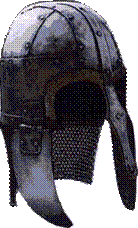
Famous NOT wearing horned Viking helmets. We found some but very little and surely would be for ceremonial use. Also, if you think about it a little, so that want big horns and angry in the middle of a battle. I think that would hinder more than anything else. The real Viking helmets had this aspect, which is pretty scary. We tend to see Vikings dressed in skins and horned helmets, but in reality, as has been proven-they did not wear horns on their helmets, was an invention of the Swedish painter Gustav Malstrom in the pictures he made in 1820 for the epic Frithiof's Saga. The objective sought by the painter to put an unrealistic horns was to portray the ferocity of the warriors from Northern Europe almost demonic beings. But the passage of history as reflected in the manner to which we have used all the wrong way and that as part of the mythology. In fact a helmet with a horn is only for display or part of an elaborate costume, but I think they should banish some myths about the warriors of the North:

berserkers Here some of the real helmets Kriegers: that other is really a viking helmet, of which they made with animal skins, logic is a replica. the appearance of the helmet hid his face and gave an aura of ferocity.

this is a town that this Viking museum in Stockholm, dating from the ninth century. The Viking heyday was between the ages VIII to XI. precious reproduction, faithful to the original, a hull of a Viking King.

Buying Out Community Service

The True Viking Helmets Helmets


These two imposing helmets with lyre-shaped horns were found in a warehouse in the late period of the Bronze age and was supposed to be reserved for ritual ceremonies. Stop arms, helmets Viks played on the front face with big eyes and crooked nose, on top, these fish are adorned with a plume set to a dividing slot. The metal is treated with the technique characteristic of the embossing rolls of the central and northern workshops. For this reason it is suspected that may have been luxury items imported into Denmark. The entry into combat during the Late Bronze Age was made to guarantee survival. All military equipment was invented and technologically prepared for it. The swords left to split into the juncture of the blade with the handle to the first assails violent. Were withdrawn from circulation rivets antiquated swords in splicing, and designed a much more robust: the sword that holds the handle to the blade using a metal pin. Is this tongue in its haft, which is drilled to accommodate the handle of wood or bone. The sheet is also stronger by adopting a bay leaf profile very sharp, sharp tip. Generalize and circulate all the swords pistiliforme sheet language or carp.

Warriors urnfield stunning round shields pregnant. We know, and so the specimens tested Clonbrin Irish (County Longford), Annandale (Leitrim) or Churchfield (County Mayo), sometimes the shields were made of leather. However, many bronze shields have been recovered from tombs and special deposits of Central Europe, Denmark and the British Isles, to demonstrate that the manufacture of the same response to a similar model, proven effective and therefore widely accepted. The shield is a circular plate, worked to hammer, with a central umbo, which fits the handle on the back. By embossing are arranged around the umbo, nerves concentric circles alternating with embossed areas (or "or studs). This design has decorative purposes, but also technical. The shield with ribs and rows of studs is a weapon stronger and resilient. The prototype had to be Central. The British Isles are large sample and use the expertise of its architects. Notable examples are the shields of Athenry (County Galway) in Ireland and Rhyd-y-Gorse, Wales. Danish bronze-smith workshops not only adopted the model in its original version, as shown by Mose Taarup shield, but it introduced changes Nordic stamp and seal. The coat of SØRUP, for example, shows a different back, incorporating a cross-shaped item in the tondo, without deviating from the established scheme. Others are unique Danish crowns adorned with circles of ridges and studs. And very special is the copy Nackhälle Swedish, in which the strings of studs bird motifs drawn in a row. better equipped fighters entered the scene in real or ceremonial with good armor. Outstanding and very famous for its timing and because it discussed a hypothetical European precedent of Mycenaean armor is the Caka (Levice) in Slovakia. The piece was found in a niche of one of the well tombs covering a huge mound. Shells such as due to a pattern Caka instrumental in metal production, such weapons. The tradition of adopting the Western bronze-smith and from it produce splendid specimens of bronze armor. Up to nine shells were found between 1974 and 1976 at the site of Petit Marais Marmesse (Haute Marne). As in the shields, the rows of studs act of reinforcement and decorative lines. In Marmesse breastplates decorated reaffirms that the adjustment of the metal parts to support the human body anatomy. Metal trim adorn and reinforce the banks. Even tacking rivets are aesthetically integrated into the game art metal.
Simple but impressive are the crest crested helmets, well represented in deposits of Bavaria, the French regions of Loire-et Oise and Cher and other Atlantic sites. One of them, recovered from a reservoir of the River Seine as it passes through Paris, may be indicative of technological assumptions that are built. Two bronze plaques are found and turned over along the backbone. Iron nails in the flanges would subject the lining to the leather. A double bevel base is the border town of weapon. The profiles of these pieces look the aesthetics of technology and this in turn will not be reluctant to produce eye-catching weapons, as well as functional.

is not known what the function of a couple helmets found in the marsh Brons in Viks, north of Zealand (Denmark), but obviously had to invest to respect and glory to its owner. Belong to the class of helmets with curved horns lyre-shaped. Its summit was adorned with a plume of feathers or other ornamental ridge, inserted into an open slot in the spine of downtown. This groove marks the meeting point between the two brass plates that form the hull, but its base emerges a curved hook, like a predatory beak. The metal plates are dotted with puffs, but the larger ones were placed, by way of an eye, below two arched lines in relief and between the said hook. Helmets are lined superhuman powers. The technical virtuosity of its manufacture should be commensurate with the rank of their audience and very determined to play a role.

We can only surmise that the Viks helmets served a religious ceremony. It has been postulated that the expert workshop that was left outside Denmark, Czechoslovakia, or in central Germany. Question difficult to prove. If so, it is likely that Viks helmets were not made to order, but would have gone to ground as gifts Nordic invested with a special social and religious significance.

Sunday, April 12, 2009

Simple Machines In Art

Heathen Frederiksborg cemetery in Odense


Through a local initiative of UÍAS Vikkelsø Solvej Blótlaug, Forn Sidr is possible that this cemetery opened in 2008, which will be reserved exclusively for members of Forn Sidr and kindsfolk his desire to be buried there (parents, siblings, spouses and unmarried, and others). (It ignagura the weekend of February 7 by Søren Fisker (One of the contributors to the IASC - International Asatru Camp Summer in Denmark) The facility will be located on municipal property not far Kirkegård assistants, Odense University Hospital.
Our member survey from 2005 showed that even among Asatruar there are some who want a coffin for burial. Therefore, the design is, that this is possible, as well as burial urn.

The main feature of the facility is 18 meters long stone xx as a ship, which is partially in the shade of a large protected tree. Around the plot is a mosaic border that marks the transition between the park of the plot, which is fully maintained as an area covered grass. There is no one grave markers, but individuals from a burial site and stored in the access management office of the cemetery. However, the facility houses a wall, where the dead can be commemorated by a plaque as a small shield.
The wall, which is about 1 meter in height, consists of a number of specific elements, which surround the whole plot. To date, only 9 elements were established. Each of the points raised has three arches, under which a circular plate at any wanted materials (wood, metal, stone, etc.) with a diameter of 50 centimeters can be fitted. Apart from basic information on the dead, we would love to see it adopted, ie, appointments or sentense, giving a view of the person who is now with us only in memory.
obviously not the plan to all Danes asatruars should be buried in Odense. Everyone is, of course, welcome, since there will be room for many people for many years. But the facility also should be viewed as a pilot project, which can act as a switch of land for similar projects in other parts of the country, where the desire / need for a pagan cemetery is present.

When installation is complete, anyone is free to reference it in any application to other municipalities or religious authority.
Solar Wheel A beautiful sculpture that the architect had done a project originally was unfortunately withdrawn from the project for economic reasons, such as the construction costs of concrete and cast iron was more expensive than the city anticipated. So even the trees grow here in heaven. But see it as a challenge, and may invest in the addition of a sculpture at a later stage.
The plant is operated in accordance with the surrounding park / cemetery, and is funded mainly user. This means that Forn Sidr is not obliged to spend a fortune to maintain annual facilities. Forn Sidr will not be obliged to cover any cost of installation, unless, as the negotiations look now, the board of Forn Sidr so wish.
Therefore, there is reason to congratulate both Forn Sidr and the entire community asatru throughout Denmark, in the new cemetery. The first "official" pagan cemetery in this country of 1000 years.


Monday, April 6, 2009

Letter Of Introduction For A Dental Hygienist

Dinamarca: una mirada cultural (by G. kimber)


Danish culture is characterized by simplicity, minimalism, egalitarianism, morals and decency. Culture is an important part of Danish life and does much to promote it. Public authorities avoid interfering in the world of art and culture, and the state generously supports the community of creators and cultural institutions, without accountability or return. The Danish applied art and industrial design is recognized worldwide for its high standards of quality, craftsmanship and functionality. He has won many awards for excellence. Georg Jensen is known worldwide for its modern design in silver. Danish design is also a known name, often associated with world famous designers and architects such as Børge Mogensen, Hans Wegner and Arne Jacobsen, who gave what is probably the most famous chair in the world today: The Ant
In the literature, Denmark gave birth to the legendary Hans Christian Anderson, whose children's stories are repeated in many nations around the world until today. One of the most popular authors of Denmark in the 90's, is the writer Peter Høeg who shot to fame in the Western world with his novel "Miss Smilla's Feeling for Snow" in 1992. Danes have distinguished themselves as jazz musicians, and the Copenhagen Jazz Festival has acquired an international reputation. In film, the Danes are credited with starting the Dogme 95 movement. The avant-garde film movement started in 1995 by the Danish directors Lars Von Trier, Thomas Vinterberg, Kristian Levring and Soren Kragh-Jacobsen, whose movement is intended to refine the film reject the costly special effects, postproduction modifications and other gimmicks. The emphasis on purity push the filmmakers to focus on the true story and the performances of the actors.

The Hygge is an important part of Danish culture and almost a national obsession. It refers to a particular state of mind or an environment where the outside world is closed, creating a warm, intimate and friendly. The desire of hygge can be found throughout the dark winter. Many Danes put much effort in creating this "cozy and comfortable" environment in their own homes. Café candles and soft music are essential elements of an atmosphere hygge.


Sunday, March 29, 2009

Brussels Plus Size Shopping

VOLKERWANDERUNG- LA MIGRACION VOLK


The Völkerwanderung Arief or migration occurred about 300 to 700 of the EC, when the Germanic tribes that came into control of the territory that became known as the Western Roman Empire. As the Empire fell apart by political and military, many tribes migrated en masse to different latitudes mainly driven by the invasion of their territories by Asian tribes, the population increase in their settlements and climate change. These raids led to the war of occupation, this resulted in the permanent establishment of various tribes in Britain, continental Europe, the Mediterranean region and North Africa. The role played by the Germanic tribes in the formation of the Middle Ages is now interpreted as a direct consequence of the practical inability of management by the Roman Empire in its entirety, space had to be filled somehow and it was replaced Germanic for leadership. Among the most important events that occurred in this stage of development of the tribes found their conversion to Christianity, it was given in various ways, some tribes were converted to Arianism while still were outside the Empire, other tribes were converted to Arianism until they entered the territories of influence of the Empire. Other tribes were converted directly from paganism to Catholicism. The most symbolic of this change of religion took place during the Saxon wars in 772-773 CE, when Charlemagne entered the territory of Saxony to subdue the tribe Engrians and destroyed its sacred symbol Irminsul. Germanic Migration


Migration of the Germanic tribes to the Roman Empire Ancient Spirituality

Before being converted to Christianity, Germanic tribes professed polytheistic spirituality. In the writings of Tacitus, he associated the patron god of the tribes with Mercury, which on certain days of the week received human sacrifices, while other gods associated with Hercules and Mars receive animal sacrifice. One of the major female deities was Nerthus, revered as Mother Earth, believed the goddess would intercede in human affairs. His shrine was on an island where there was a magic forest. He spent a carriage covered by a veil and only a high priest could touch it, it mentions that the priest could see the goddess to enter his carriage. Pulled by oxen, the coach had to walk the towns and everywhere the submission was made a great feast. During the passage of the goddess, the tribes did not go to war or even touched the guns. When the priest decreed that the goddess was over his dealings with men for that period, the carriage was washed along with her veil, in a secret lake. For the slaves who helped in the task of purifying the chariot were put to death and then thrown into the lake. Tacitus also describes the tribes did not use temples to worship their gods or worship in the human representations. Instead they consecrate woods and groves to individual gods. Divination and sorcery were common and were practiced in the Greek methods perceived as simple, using specific woods and special marks. The priests solemnly invoked the gods with eyes focused on heaven and respected their designs in a way not insidious; also interpreted magic in the singing of the birds, horse behavior and individual fighting between enemies.


Volks Germanic

Alamannen: early formed the Confederation Suebi tribes, along with Marcomanni, Hermunduri and Quadi. From the regions surrounding the River Elbe, Alammanes riders were first seen by the Romans in the year 213 BCE. In 233 BCE, they ransacked the strong Romans left, reaching the Saar and Moselle rivers in the west and Lake Constance in the south were also established in the middle of the river Elbe. Appeared in the story again in the years 242, 253 & 254 BCE, in the years 259 & 260 BCE reached Rhaetia and Mediolanum (Milano). The Franks were defeated in 496 or 497 CE in Tolbiacum. Carried by the migration of the Franks in the sixth century, the Alamanni had to enter the territory of Alsace in the west and the river Lech in the east, the south crossed the Rhine and Lake Constance, reaching the Alpine valleys. There is an important archaeological site Alamanni, a cemetery in the town of Schretzheim. According to research Herbert Schutz, settlements with names ending in "ingen", "heim", "statt" and "weil" were established between the V-VII centuries CE, while the settlements with endings "dorf", "Stetten" "hifen", "weiler" "bach", "beur", "Hausen", "wang" and "Felden" were established after the seventh century. In the present descendants of the tribes Alammani can be found mainly in the south of Germany, Baden-Württemberg and Bavaria and Austria, Vorarlberg, also in the Germanic-speaking part of Switzerland and the Alsace region France.

Anglos, were a tribe who came to Britain from the Peninsula Jutland. They lived in Schleswig-Holstein in northern Germany around the year 100 CE. This tribe is related directly to Thuringia and example of this can be seen in the law written IX century "Lex et Werinorum Angliorum, hoc est, Thuringorum" where both tribes legally related. Migration to Britain occurred during the V and VI together with the tribes Sachsen, settled in the north, east and center of Britain, places that later became known as East Anglia, Deira and Bernicia. Were also mentioned by Tacitus in Germania, "after Langobardos came Reudigni, Planes, Angli, Varini, Eudoses, Suarines and Nuitones, all guarded by rivers and forests. There is nothing remarkable about them individually, but share a common worship of the goddess Nerthus, or Mother Earth.. "Are also discussed by Ptolemy mentions them as immigrants in the second century. At present the descendants of the tribes Angli can be found in the region of Schleswig-Holstein in Germany and southern England. Burgundians, were a Germanic tribe that was established near the Vistula before migrating to the west of the Rhine River valley. They were first mentioned in 278 CE when the Vandals invaded Rhaetia. Were neighbors of the Alamanni, who struggled with some sites salt about 369 CE. In 413 CE the Roman emperor Honorius recognized them as a tribe federated to Rome, giving them land, their capital was Worms. The EC 435 was defeated by a coalition led by Aetius Roman soldiers and mercenary Huns, this resulted in the defeat and death of 20.000 Burgunder. Federated tribe were revived as Rome in 443 CE in Western Switzerland, Eastern France. Gundobad King established the capital in Geneva Switzerland, and I think the "Lex Burgundionum, or Gundobada Lex." Later he became a double kingdom, with a capital in Geneva and one in Lyons. In 532 CE were conquered by the Merovingian Franks and their kingdoms were divided between the Frankish kings. About the origin of the tribe, the archaeological evidence is known today shows that in the group of Lebus-Lausitz about 100 CE, known as a cultural group from Southeast Przeworsk later settlements of the Burgundians in the middle of the river Oder. In the present descendants of the tribes can be found in Burgundy in eastern France, southwest Switzerland and northwest Italy. Cheruscos: they were a tribe that inhabited the river Rhine and amended in the forests of West Germany. They were protagonists of the Battle of Teutoburg in 9 BCE. Arminius, one of its leaders, defeated three Roman legions under the command of Varus governor. In this the descendants of the tribe Cherusci are scattered among the population of the region Saxony Lower Saxony in Germany.

Franks, were a tribe that appeared in history in the year 231 CE when the Roman legions fought Bonna amended them in the lower River Rhine. Franks's name however, was described to 256 CE. According to Gregory of Tours free tribes claimed descent from the tribe Sicambri, integrating a coalition that inhabited the lower and central regions of the Rhine River on both sides of the river, as Amsivari, Bructeri, Batavia, Chattuari, Chamavi, Sugambri, Tencteri, Tungri and Usipi. In 355-358 CE, the Roman Emperor Julian found along the river Rhine under the control of the Franks and agreed a peace treaty with them, giving them much of Gaul Belgium and turning them into a federated nation of the Empire. Conquered much of Central Europe for 800 EC and are responsible for the conversion to Catholicism of the majority of the Germanic tribes. In the present descendants of the tribes Free can be found in the Netherlands, in western France and eastern Germany.

Goths: they were a tribe from southern Sweden, which later migrated to Eastern Europe, in the Vistula river amended. During the early third century CE they migrated from the Vistula River in Poland today, north of the Black Sea. The most important leader of the Goths was Ermanaric, his kingdom was destroyed by the Huns from 370 to 380 CE. After the defeat, a part of the tribe migrated westward to form new kingdoms in present Italy and Spain. The other part of the tribe remained in the east to form a new kingdom, whose tribes were the most representative and Kolbjazi Varangian. The Slavic peoples Goths called "Rus", meaning people blond or red hair. In the present descendants of the Gothic tribes may be found in Sweden in the Baltic region, in Spain and Central Europe.

Jutes, were a tribe originally from the peninsula Jutland, Denmark today. Part of the tribes migrated Jutas EC V century along with the Saxons and the Angles to Britain. Their main settlements were the county of Kent and the Isle of Wight. In the present descendants of the tribes Jutas can be found in Denmark and southern England. Langobardos: they were a tribe from Scandinavia. According to legend Paolo described by Deacon in the eighth century CE, the tribe was originally known as the Winnili and received the name "Langobardos" or "long beards" directly from God Godan in sponsoring a battle against the Vandals. Amended appear later in the River Elbe in Lower Saxony, and then migrate the region of Bohemia and then of Pannonia. In 569 CE the tribe migrated to Italy to establish a kingdom of a legacy that still exists nominal capital of Lombardy and Milan. In the present descendants of the tribes Langobardas can be found in Northern Italy in the region known as Padania or Langbard.
Saxons, were a tribe first mentioned in history by Ptolemy in 150 CE, the author comments that came from the Lower Jutland and Schleswig-Holstein in Germany. Among the original tribes that made up the Sachsen can find the Reudigni, Planes, Agradingun, Angerona Aringon, Astfalon, Bardongavenses, Derlingun, Firihsetan-Virsedi, Guddingen-Göttingen, Holtsaeten, Nordalbingi, Nordliudi, Nordsuavi, Norththuringun, Sahslingun, Scopingun, Scotelingun, Steoringun, Sturmarii / Sturmera, Thiadmariska, Waldseton, Waledungun, Wigmodia-Wihmodi and Uuestfali. The Saxons migrated en masse along with the Angles and the Jutes in the V century CE to Britain, although they were mentioned in that region since 365 CE. In the present descendants of the Saxon tribes can be found in the northern, eastern and central Germany.
Sueba: it was a federation of tribes that included the Marcomanni, Semnones and Hermunduri (precursors of Thuringia and Alamannen).

Thuringia, were a tribe that apparently came from the Elbe and Saale River in central Germany today. They were known as jockeys and practitioners of burial, showing possible links with the cultures of the eastern steppes. Thuringia originally came from the tribe of Hermunduri and lived in coalition with some Anglos, Warni, Langobardos, Ostrogoths and Alamannen. The Thuringia were subdued by the Franks in the sixth century CE with the aid of the Saxons. In the present descendants of the tribes can be found in Thuringia in central Germany.

Vandals: They were a tribe from Przeworsk culture, originally from Poland. The tribe migrated from this region into Gaul in 406 CE, under the command of King Gunderic. Then attacked Spain in 409 CE. Following this migration was with them a band of Confederate Alamannen Suebi, who created a kingdom in Galicia. After the king of kings followed Gunderic Gaiseric, Huneric and Trasamund. For the 496 CE, the Vandals left Spain to migrate to Africa. The kingdom of the Vandals finished between 533 and 534 CE. Modern concept of the Volk

The idea of a nation of Germanic peoples was expressed openly in the nineteenth century writers, thinkers and artists after the Napoleonic Wars, as Johann Gottfried von Herder, Anthony Smith, Richard Wagner, Friedrich Nietzsche, Johann Goethe, who called for an ethnic nationalism, a form of social organization in which the state derives its political legitimacy of the cultural history of ethnic groups. However, this social identity has been implicit since the Middle Ages and was the fuel for the Protestant Reformation, which drove many Germanic territories so the political and religious power of the Roman Catholic Church. At present there are many groups that support and promote Reconstructionism Volk Traditionalist throughout the Western world, Europe, America and Oceania.