
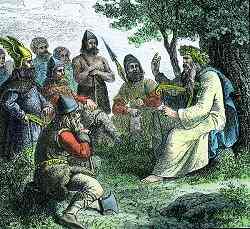
skald was a member of a group of poets, courtly poetry (Icelandic: dróttkvæði) is associated with the courts of Scandinavian and Icelandic leaders during the Viking age, who composed and performed interpretations of aspects of what we now characterize as Old Norse poetry (the complementary aspect is the anonymous Eddaic Poetry).
The most common meter is dróttkvætt Skaldic poetry. The theme is generally historical and eulogic, detailing the facts of the skald king.
demands Skaldic techniques as being equal to the complicated forms verse dominated by Welsh and Irish bards ollaves, and like those poets, much of verse consisted of panegyrics Skaldic kings and aristocrats, or memorials and testimonials to their battles. The kings and nobles, for their part, audiences were not only intelligent and gifted Skalds praise for some of them were poets in their own right. Content
* * 1 Etymology 2 History * 3 Poetry
Skaldic
or 3.1 Forms of poetry Skaldic
or 3.2 or 3.3 Kennings
Skaldic Poems notable Skalds
* 4 * 5 See also
* 6 External Links
Etymology
counterparts skald West Germanic are scop. Not unlike scop, which relates to scoff modern English, the name continues in English skald scold, reflecting the centrality of imitation taunts Germanic poetry. The word may be ultimately related to Proto-Germanic * skalliz "sound, voice, shout" (OHG skal "sound"). OHG has skalsang "song of praise, psalm." Skell means "sound, clang, resound. The variant stem etymologically identical with OHG skelter skald-stem (Proto-Germanic * skeldan) means" to scold, blame, accuse, insult. " The person who does is insult or skeltāri skelter.
History We can trace the 9th century poetry Skaldic previous Boddason Bragi and his Ragnarsdrápa, the oldest poem in the Norse poem also surviving preserved in stone Eggjum epigraphically. Thorbjörn Hornklofi's Glymdrápa the late 9th century is the oldest surviving poem dróttkvætt the metro, and Karlevi Runestone from the late 10th century is the oldest surviving text on the subway. From the 10th century, the poems begin syncretized pagan and Christian elements. In the 11th century, the professional skald is extinct in continental Scandinavia with progress Christianisation of Scandinavia, but survives in Iceland in the thirteenth century. As the profession was threatened with extinction in Iceland also, Snorri Sturluson compiled the Prose Edda as a manual with the aim to preserve an appreciative understanding of his art. Snorri Heimskringla also preserves many poems. Poetry
Skaldic verse
Most Nordic Viking time came in one of two ways: Eddic or Skaldic. Eddic verse was usually simple in terms of content, style and meter, dealing largely mythological or heroic content. Skaldic verse was inversely complex, and generally made a tribute or homage to a particular Jarl or king. The operation of Skaldic poetry was spoken, not sung or chanted.
Unlike many other literary forms of the time, a lot of poetry Skaldic is attributable to an author (called a skald), and these powers can be relied on with a reasonable degree of confidence. Many Skalds were men of influence and power, and biographically were observed as well. meter is ornate, usually dróttkvætt or a variation thereof. syntax is complex, with the sentences commonly interwoven with Heiti kennings and are frequently used and free.
Skaldic's poetry was written in variants and dialects in of Old Norse languages. Technically, their verse was usually a form of alliterative verse, and almost always use dróttkvætt stanza (also known as Metro Court or Lordly). Dróttkvætt is effectively an eight line form, wjere each pair of lines is a single long line original is written conventionally as two lines.
Forms of poetry Skaldic
Skaldic forms of poetry are:
* Draper, a long series of stanzas (usually dróttkvætt), with a refrain (stef) at intervals. * Flokkr dræplingr
or a shorter series of such stanzas without refrain.
* Lausavísur, a single stanza of dróttkvætt said to have been improvised impromptu for the occasion it marks.
Skalds also composed satire (níðvísur) and very occasionally, erotic verse (mansöngr). Kennings
the verses of the Skalds contain a profusion of kenning, fixed metaphors found in most northern European poetry of the time. Kennings are devices ready to provide a standard image to form a half-line to fit alliterating dróttkvætt requirements, but substantially greater technical demands of the verse required that these devices Skaldic are multiplied and made to meet their demands for skill and wordplay. These images can therefore become somewhat tight, at least those who can not catch allusions that lie at the root of many of them. Poems
Skaldic
Most Skaldic poetry that we are poems written to individual kings by his court poets. They typically have historical content, battles and other events relating carrier king.
* Glymdrápa - The facts of Harald Fairhair
* Vellekla - The facts of Hákon Hlaðajarl.
* Bandadrápa - The facts of Eiríkr Hlaðajarl.
Some poems are Skaldic surviving mythological content.
* Þórsdrápa - the god Thor Draper tell the story of one of his expeditions big-hitting.
* Haustlöng - relates two stories of the mythology as painted on a protector as the poet.
* Ragnarsdrápa - Lists four tales of the mythology as painted on a protector as the poet.
* Húsdrápa - Describes as mythological scenes carved on panels of the kitchen.
* Ynglingatal - describes the origin of the Norwegian kings and the history of the House of Yngling. Is preserved in the Heimskringla.
This could be added two poems that related death a king and his reception in Valhalla.
* Hákonarmál - The death of King Hakon the Good and his reception in Valhalla.
* Eiríksmál - Death of King Eiríkr and its reception in Valhalla.
Someone else was composed as pieces of circumstance, such as those by Egill Skallagrímsson
* Sonatorrek - A lament on the death of s Egill'hijos
* Höfuðlausn - praise for King Eiríkr Bloodaxe, that saved the head of author
* Arinbjarnarkviða - In praise of the poet's friend
Arinbjörn notable Skalds Skalds
More than 300 are known from the period between AD 800 and 1200. Notable names include: * Bragi Boddason
"old", author Ragnarsdrápa (possibly the basis for Bragi, the god of poetry) Hornklofi Thorbjørn
* * Þjóðólfr of Hvinir
- author of Haustlöng and Ynglingatal
* Einarr Skulason , author of Geisli
* Eyvindr Finnsson, also known as skáldaspillir of Eyvindr or Eyvindr the Plagiarist, the author of Hákonarmál and Háleygjatal
* Goðrúnarson author Þórsdrápa Eilífr
* Tindra Sigurðarson'poetas Hákon Hallkelsson one of the court s
* Egill Skallagrímsson Sonatorrek author, and Arinbjarnarkviða Höfuðlausn
* Einarr Helgason "Skálaglamm", "flashing coins" - the author of Vellekla
* Gunnlaugr Illugason nicknamed "Ormstunga", "worm-tongue" because of his propensity for satire and invective
* Uggason author Húsdrápa Ulfr
* Kormákr Ögmundarson main character Kormáks Saga Óttarsson
* Hallfreðr court poet of King Óláfr Tryggvason
* Arnórr Thordarson, "Jarlaskald" the Skald of the Earls
* King Haraldr Harðráði
* Sigvatr Snorri Sturluson Thordarson
* * Loftunga of Þórarinn
* Þór Steinfinnsson Jökull
* Þórvaldr Hjaltason, a skald of King Eric the Victorious Óttarr
* Svarti of a skald at the court of King Olof Skötkonung and Olaf the Stout.


0 comments:
Post a Comment